The second part turns to Inca religion, record-keeping, daily life, and the empire's fall. At the centre was Inti, the sun, with the Sapa Inca ruling as his descendant; and beneath that, a landscape alive with huacas — sacred places, stones and springs — linked to Cusco by invisible ceque lines.
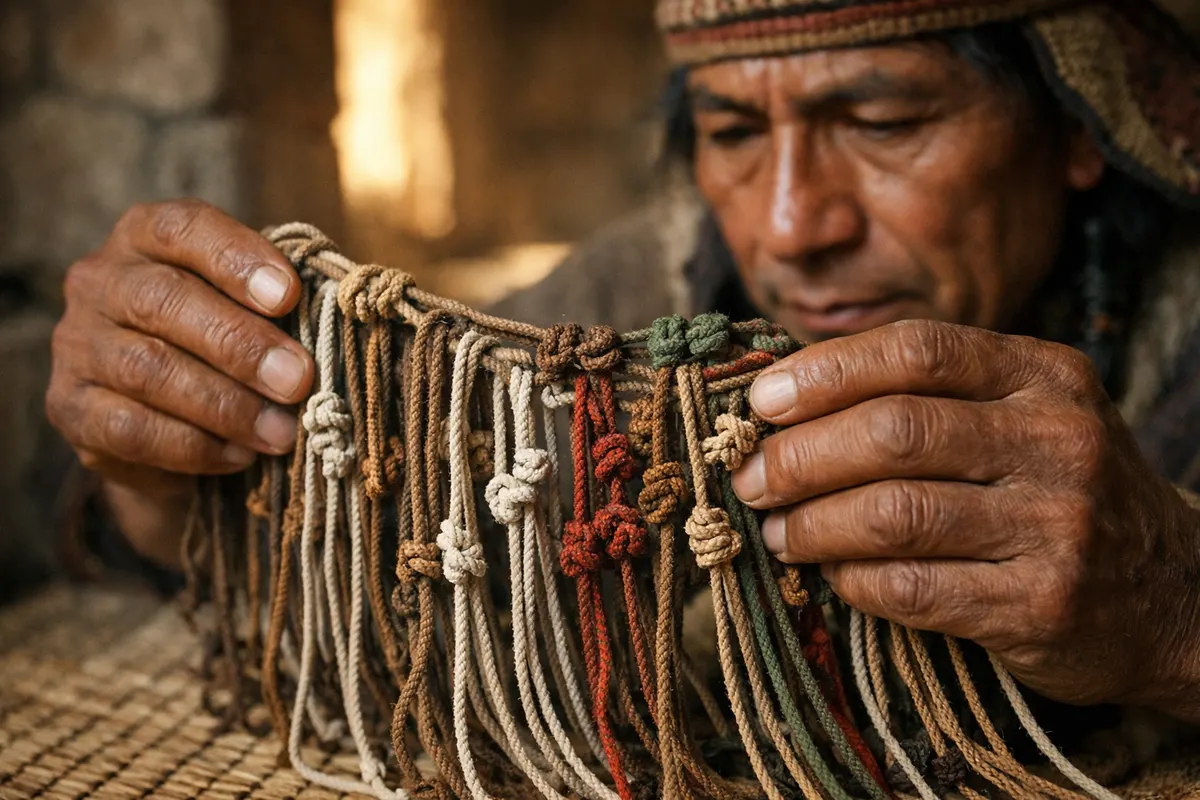
The Inca kept records without writing as we usually define it. The khipu, a system of knotted and coloured cords, recorded census figures, tribute and calendars with enough reliability to administer millions of people, and Spanish chroniclers wrote that the khipu keepers also used them to recite the histories of the Inca rulers.
The fall came quickly. An epidemic reached the Andes ahead of the Spanish, killing the emperor Huayna Capac and his heir, and a civil war followed between Atahualpa and Huáscar. Pizarro arrived with fewer than two hundred men just as Atahualpa's generals defeated Huáscar, and Inca resistance continued at Vilcabamba until 1572.
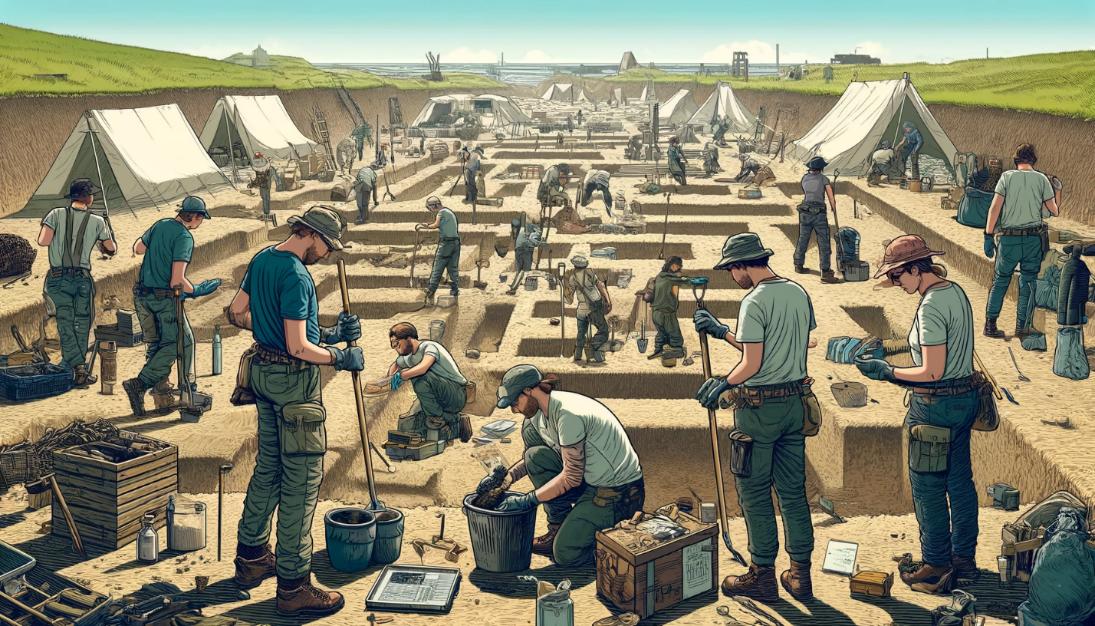
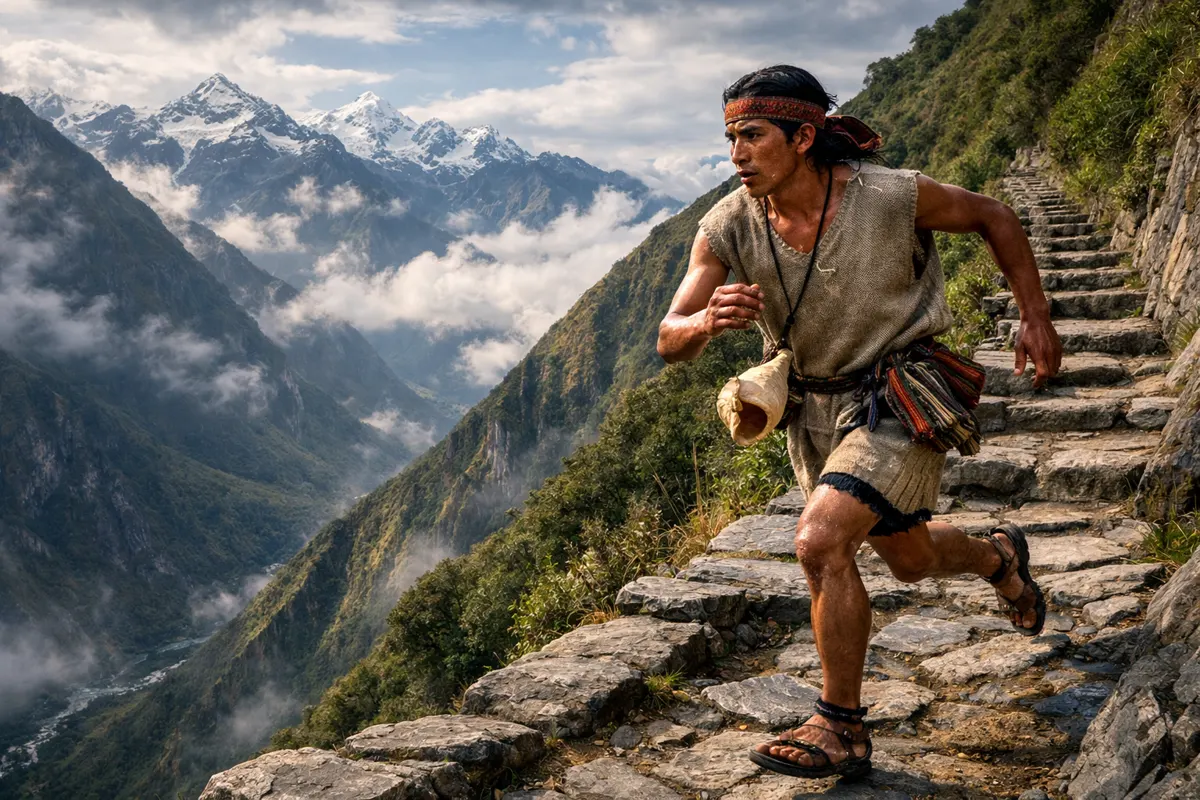
An Inca record keeper reading a quipuExcavating an Inca siteA chasqui messenger running the Inca road
Look for these
Record-keeping with knotted cords
An epidemic arriving before the Spanish did
The civil war between Huáscar and Atahualpa
What this chapter teaches
Innovative engineering and architecture
Agricultural mastery
Resilience in the face of adversity
Who you will meet
Huayna Capacc. 1493–1527 — whose death from disease began the end
Huascarc. 1500–1532 — one half of the civil war
Atahualpac. 1502–1533 — the other half, and the last emperor to rule freely
While this was happening in the Americas, these were happening everywhere else.
Gutenberg's printing press
c. 1440 AD
The Ming Dynasty in China
1368 – 1644 AD
Vasco da Gama reaches India by sea
1498 AD
The Protestant Reformation begins
1517 AD
How to use this lesson. Read the chapter first — then work across the tabs in
order. The music hands you the era in a song, the subject matter expert puts a face to the
history, the reading takes you past the chapter, the video teaches it, the activity puts it
in your hands, and the exam at the end is how you check it stuck.
Read first
pages 175–183 —
The History of Ancient America: Ultimate Guide to Learning, the lesson plan and
activity book. This is where the activity on tab six comes from.
pages 195–212 —
Living History: Ancient America, Told By Those Who Were There, where the people
on the Subject Matter Expert tab tell it themselves.
The Music of This Era
Nothing sticks like a song. Written for this chapter, and worth having on while you do the activity.
Listen for the details. A specialist tells the story as someone who was there. The
things they mention in passing — what they ate, how they travelled, what they made, who
ruled them — are the details worth writing down.
Heroes & Villains — told in the first person
Atahualpa
Atahualpa tells his story of the civil war for the Inca kingdom
0:00
Who they were
Atahualpa · The last independent Sapa Inca, d. 1533
A son of Huayna Capac. After Huayna Capac and his heir died around 1527, Atahualpa and his brother Huáscar fought a civil war for the throne, which Atahualpa won. In November 1532 he met Francisco Pizarro's company of fewer than 200 men at Cajamarca, where he was taken prisoner. For his ransom he had a room filled once with gold and twice with silver. The Spaniards executed him in July 1533. Listen for how he describes the empire he inherited and the war with his brother.
More voices from this chapter
0:00
Francisco Pizarro, from poor soldier to conqueror of the Inca
Who they were
Francisco Pizarro · Spanish conquistador, c. 1478–1541
A soldier from Trujillo in Extremadura who led expeditions down the Pacific coast of South America in 1524 and 1526 before sailing to Peru in 1531. At Cajamarca in November 1532 his force captured the Sapa Inca Atahualpa, and in 1533 it entered Cusco. He founded the city of Lima in 1535. His partnership with Diego de Almagro ended in war between their followers, and Almagro was executed in 1538. In June 1541 Pizarro was killed in Lima by Almagro's supporters. Listen for how he describes the expedition to Cajamarca.
These are from Living History: Ancient America, Told By Those Who Were
There, which carries the same accounts in print.
Beyond the chapter
Additional Reading
The second part of the Inca story follows the empire's records, its religion, and its fall — told by the Spaniards who were at Cajamarca and by Andean writers of the next generation.
Excavating an Inca site
The khipu recorded numbers: the type of knot gives the digit, its position on the cord gives the place value, and the system is decimal. Colonial records describe the khipukamayuq — the keepers — reading out censuses, tribute and dates from them, and Spanish courts accepted khipu accounts as evidence in the sixteenth century. The chroniclers also wrote that the keepers recited the histories and genealogies of the Inca rulers from their cords. About 1,400 khipus survive. The Third Council of Lima in 1583 ordered those used in the old religion to be destroyed.
An epidemic reached the empire before the Spanish did. It killed the emperor Huayna Capac around 1527 and his named heir, and his sons Huáscar and Atahualpa went to war over the throne. Atahualpa's generals had just defeated and captured Huáscar when Pizarro landed with fewer than 200 men.
At Cajamarca in November 1532, Atahualpa came into the square with thousands of attendants to meet the Spanish, who attacked from hiding and took him prisoner. From captivity he still gave orders across the empire: he offered a room filled with gold and twice over with silver for his freedom, and at his command it was carried to Cajamarca from temples and palaces far and wide. In July 1533 the Spaniards tried and executed him.
The Inca state did not end there. Manco Inca rose against the Spanish in 1536 and besieged Cusco. A neo-Inca state held out at Vilcabamba in the mountains, with its own rulers, until the last, Túpac Amaru, was captured and executed in Cusco in 1572 — forty years after Cajamarca.
Four things worth knowing
About 1,400 khipus survive. Harvard's Khipu Database Project has matched a handful to Spanish colonial censuses of the same villages.
Spanish colonial courts accepted khipu accounts as evidence, with a khipukamayuq reading them aloud.
Dead Inca rulers were preserved as mummies and kept their palaces, servants and estates, and were carried out to take part in festivals.
Túpac Amaru II, who led a great rising against Spanish rule in 1780, took his name from the last Inca of Vilcabamba.
Excavating an Inca site
The second part of the Inca story follows the empire's records, its religion and its fall. It is told by the Spaniards who were at Cajamarca, and by Andean writers of the next generation.
The Sun and the sacred land
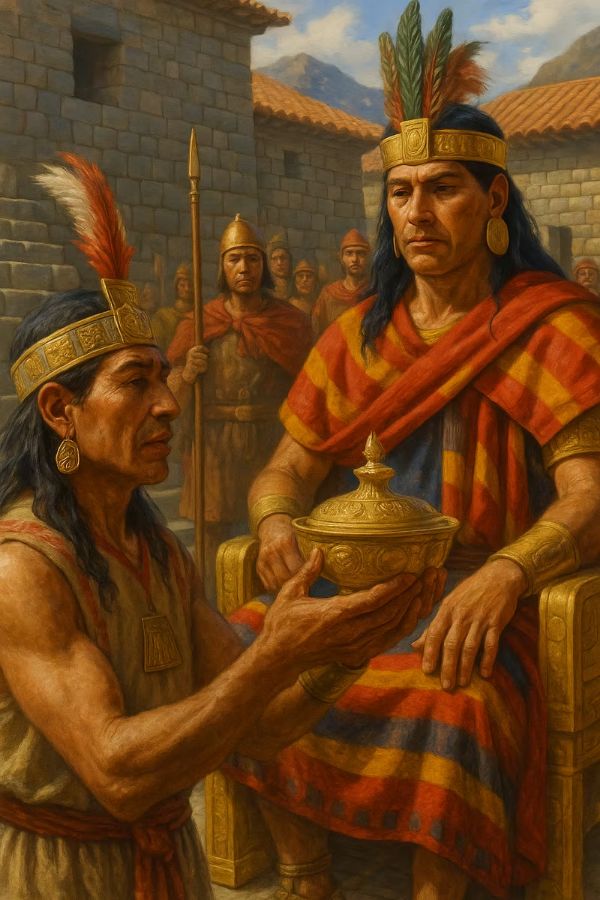
At the centre of Inca religion was Inti, the Sun. The emperor, the Sapa Inca, ruled as the Sun's descendant, so his power was religious as well as political. Across the land were huacas — sacred places, stones and springs — linked to Cusco by lines called ceques.
Records in knots
The khipu was a bundle of knotted, coloured cords that recorded numbers. The type of knot gives the digit, and its position on the cord gives the place value — ones, tens, hundreds — in a system based on ten. Records from the Spanish colonial period describe the khipukamayuq, the keepers of the cords, reading out censuses, tribute and dates from them. Spanish courts accepted khipu accounts as evidence in the sixteenth century. The chroniclers also wrote that the keepers recited the histories and family lines of the Inca rulers from their cords. About 1,400 khipus survive. In 1583 the Third Council of Lima, a meeting of church leaders, ordered those used in the old religion to be destroyed.
A sickness and a civil war
An epidemic reached the empire before the Spanish did. Around 1527 it killed the emperor Huayna Capac and the son he had named as heir. Two of his other sons, Huáscar and Atahualpa, then went to war over the throne. Atahualpa's generals had just defeated and captured Huáscar when Francisco Pizarro landed with fewer than 200 men.
Cajamarca
At Cajamarca in November 1532, Atahualpa came into the town square with thousands of attendants to meet the Spanish. The Spanish attacked from hiding and took him prisoner. Even in captivity he still gave orders across the empire. He offered to fill a room with gold, and twice over with silver, for his freedom, and at his command the treasure was carried to Cajamarca from temples and palaces far and wide. In July 1533 the Spaniards put him on trial and executed him.
The Inca state carries on
The Inca state did not end there. Manco Inca rose against the Spanish in 1536 and laid siege to Cusco. A new Inca state held out at Vilcabamba in the mountains, with its own rulers. The last of them, Túpac Amaru, was captured and executed in Cusco in 1572 — forty years after Cajamarca.
Four things worth knowing
About 1,400 khipus survive. Harvard's Khipu Database Project has matched a handful of them to Spanish colonial censuses of the same villages.
Spanish colonial courts accepted khipu accounts as evidence, with a khipukamayuq reading them aloud.
Dead Inca rulers were preserved as mummies. They kept their palaces, servants and estates, and were carried out to take part in festivals.
Túpac Amaru II, who led a great rising against Spanish rule in 1780, took his name from the last Inca ruler of Vilcabamba.
Excavating an Inca site
This part of the Inca story is about how the Inca kept their records, what their religion taught, and how their empire ended.
People and their jobs
The Sapa Inca was the emperor. The Inca said he was the son of Inti, the Sun.
The khipu keeper (khipukamayuq) looked after the knotted cords that held the empire's numbers. He could read out how many people lived in a village, and what they owed.
Priests cared for the temple of the Sun in Cusco and the holy places all over the land.
Runners carried messages along the roads.
The royal servants kept caring for a ruler even after he died. Dead Inca rulers were preserved as mummies. They kept their palaces and servants, and were carried out to join the festivals.
Things they made and used
A khipu is a bundle of coloured cords with knots. The kind of knot gave the number, and where it sat on the cord showed ones, tens or hundreds. About 1,400 khipus still survive.
A huaca is a holy place or thing — a special stone, a spring or a mountain.
The temple of the Sun in Cusco had walls covered with sheets of gold.
The ransom room. When the Spanish captured the ruler Atahualpa, he offered to fill a room with gold, and twice over with silver, to be set free.
Animals
Llamas carried goods along the roads. Great herds of them belonged to the Sun and to the ruler.
How the empire ended
A sickness came before the Spanish did, and the emperor Huayna Capac died. Two of his sons, Huáscar and Atahualpa, then fought over the throne. In 1532 a small Spanish force led by Francisco Pizarro captured Atahualpa at Cajamarca. Some Inca rulers kept their own kingdom in the mountains at Vilcabamba for forty more years.
Where this comes from. Everything on this page is drawn from the records of the time —
letters, logs, chronicles, codices and laws — and from what excavations have found. Where a
fact rests on a single account, the page names it.
Living books for Week 3 — South America
The Inca Empire, the Mapuche, and other South American tribes
The chapter taught on video — from the Adventure Box podcast series,
week 3 of Ancient America.
W4:D1 — The mysteries and controversies of the Inca empire
🎧 Podcast episode — Coming soon
From the Ultimate Guide — pages 175–183
Activity
Hands-on work from The Ultimate Ancient America Lesson Plan and
Activity Book. Pick one — you do not need to do all of them.
Make and Read a KhipuAges 10–16
Using string of several colours, agree a code — knot type for digit, position for place value, colour for category — then record the class's data and have another group read it back.
Why it is worth doing. Students discover that a record-keeping system needs an agreed convention, and what is lost when the readers die.
Objective
To learn about the Inca system of record-keeping, using quipus.
Materials Needed
Colored strings or yarn
scissors
beads (optional)
Instructions
Explain what a quipu is, and how the Incas used it for record-keeping.
Provide students with colored strings, and demonstrate how to make simple knots.
Assign different colors and knots, to represent numbers or information (e.g., red for food supplies, blue for population counts).
Have students create their own quipus, to represent a series of numbers or data points.
Discuss how the Quipu system helped the Incas manage their vast empire.
Learning Outcome
Students will understand an ancient method of data management, and appreciate the ingenuity of Inca record-keeping.
Inca Culture and Daily Life PresentationAges 10–16
Each group takes one aspect — food and freeze-drying, textiles, roads and chasquis, religion and huacas, the mit'a — and presents it to the class.
Why it is worth doing. Students build a whole picture of a society from its parts.
Objective
To research and present various aspects of Inca culture, including religion, social structure, and daily life.
Materials Needed
Access to research materials (books, internet)
presentation tools (posters, slideshows, etc.)
Instructions
Divide students into groups, and assign each group a specific aspect of Inca culture (e.g., religion, social hierarchy, daily life, art and music).
Have each group research their topic, and create a presentation.
Encourage the use of visuals, such as pictures and diagrams, to enhance their presentations.
Each group presents their findings to the class.
After all presentations, facilitate a discussion on how these aspects are interconnected, and contributed to the Inca civilization’s success and downfall.
Learning Outcome
Students will gain a comprehensive understanding of various elements of Inca culture, and develop research and presentation skills.
The Monthly Adventure Box ships
the craft kit for this era, so most of these arrive with the materials already cut.
Activity journal
Write about doing this activity. What did you actually make or do? What surprised you? What was harder than you expected, and what would you do differently next time? Then say one thing about Incan Civilization — Part 2 that you understand better now than you did before you started.
Saved on this device as you type. Send to my parent account submits it to the
Xogos parent/teacher grade page — you can keep editing and send again.
Extra
Do not have the book with you? These cover the same chapter, free, on
our blog — read them on a phone at a kitchen table or in the back of a car.
8 questions drawn from a pool of 16, plus one to
write in your own words. Open book — you are meant to look things up.
How this one works. You get four attempts. Each retake takes 5 points off
the top, never more than 20 — so a perfect paper passes however many tries it took. The
pass mark is 80%, and passing is what opens the next chapter. Every attempt draws
a different paper.
Sign in to take the exam
Your attempts, your score and your place in the course are kept on your
account, so the exam needs to know who you are.