Tawantinsuyu — "the four parts together" — was the largest empire in the pre-Columbian Americas, running some 2,500 miles down the Andes and holding perhaps ten to twelve million people. It grew to that size in under a century.
It was held together by roads. The Qhapaq Ñan ran around 25,000 miles through some of the most difficult terrain on earth, with rope suspension bridges over gorges, storehouses at intervals, and chasqui runners working in relay who could carry a message hundreds of miles in a day.
This first part covers how the empire was built and governed: the mit'a labour tax paid in work rather than goods, the resettlement of whole populations to prevent rebellion, the vertical archipelago that let one community farm several climate zones at different altitudes, and stonework so precise that blocks fit without mortar and still stand after centuries of earthquakes.
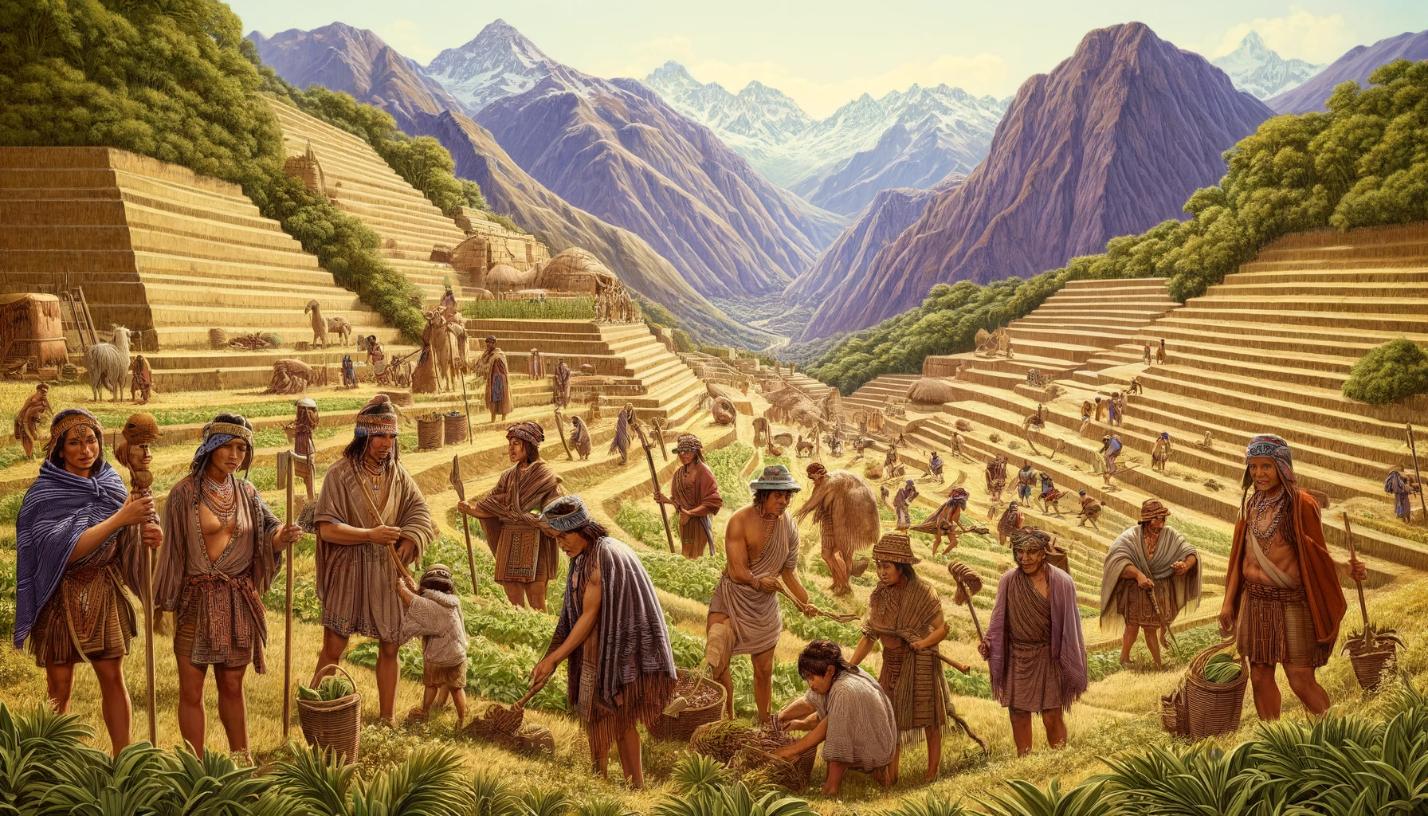
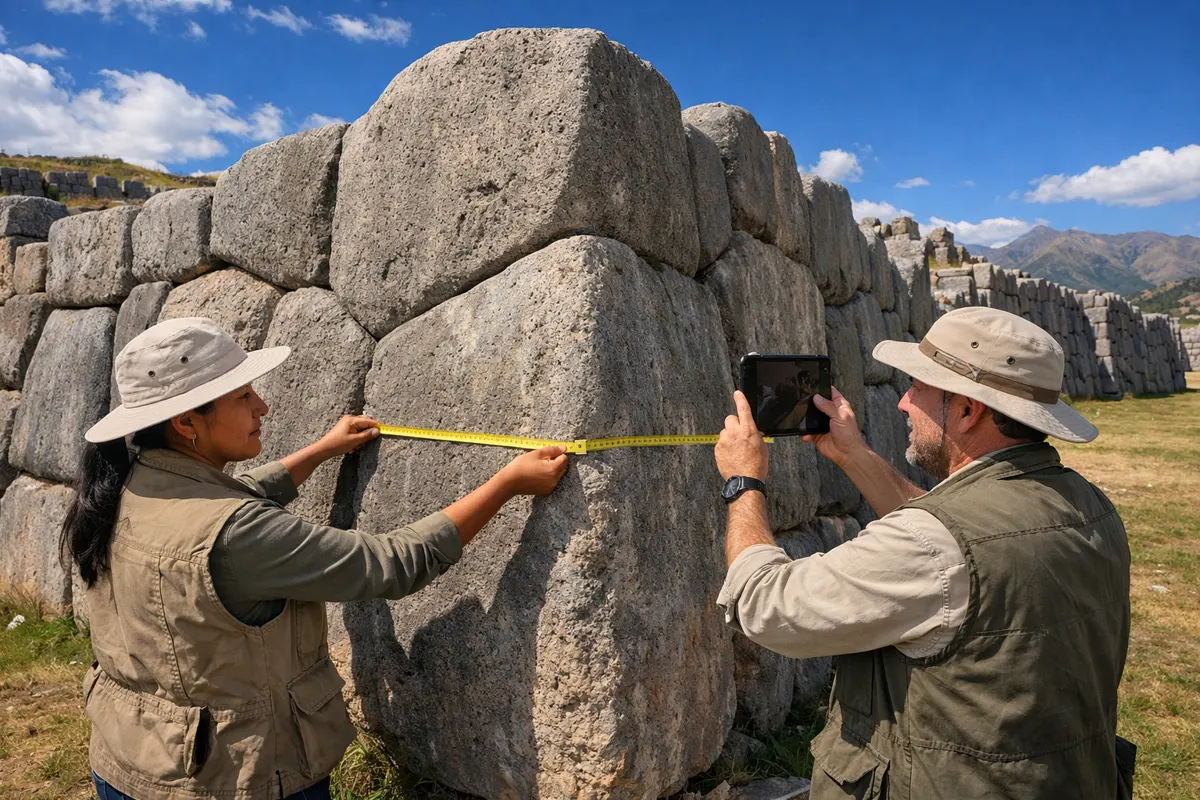
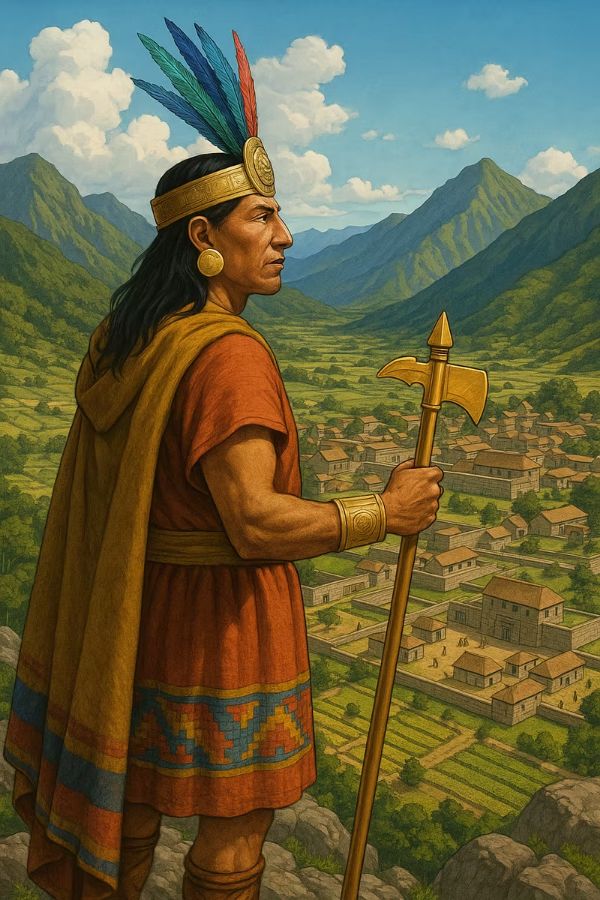
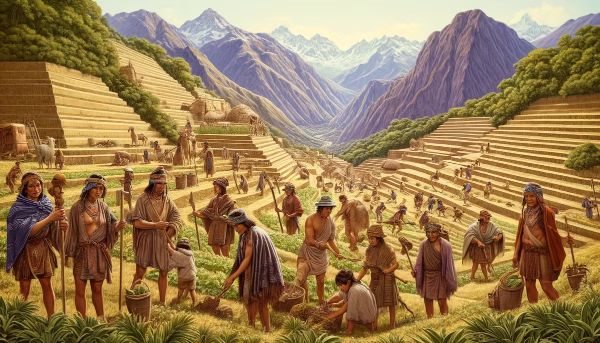
Inca terraces in the AndesArchaeologists measuring the fitted stone walls of SacsayhuamánPachacuti Inca Yupanqui, who built the Inca Empire
Look for these
Administering an empire without the wheel, without iron, and without writing as we define it
Roads as the skeleton of a state
Taxation paid in labour rather than money
What this chapter teaches
Visionary leadership
Centralized administration with local autonomy
Collective responsibility and social welfare
Incorporation of diverse cultures
Who you will meet
Pachacuti Inca Yupanquic. 1438–1471 — who turned a kingdom into an empire
Topa Inca Yupanquic. 1471–1493 — who pushed it to its greatest extent
While this was happening in the Americas, these were happening everywhere else.
The Songhai Empire
c. 1430 – 1591 AD
The Ming Dynasty in China
1368 – 1644 AD
The fall of Constantinople
1453 AD
Columbus's first voyage
1492 AD
How to use this lesson. Read the chapter first — then work across the tabs in
order. The music hands you the era in a song, the subject matter expert puts a face to the
history, the reading takes you past the chapter, the video teaches it, the activity puts it
in your hands, and the exam at the end is how you check it stuck.
Read first
pages 166–174 —
The History of Ancient America: Ultimate Guide to Learning, the lesson plan and
activity book. This is where the activity on tab six comes from.
pages 176–194 —
Living History: Ancient America, Told By Those Who Were There, where the people
on the Subject Matter Expert tab tell it themselves.
The Music of This Era
Nothing sticks like a song. Written for this chapter, and worth having on while you do the activity.
Listen for the details. A specialist tells the story as someone who was there. The
things they mention in passing — what they ate, how they travelled, what they made, who
ruled them — are the details worth writing down.
Heroes & Villains — told in the first person
Pachacuti Inca Yupanqui
Pachacuti tells his story of uniting the Inca empire
0:00
Who they were
Pachacuti Inca Yupanqui · Sapa Inca, r. 1438–1471
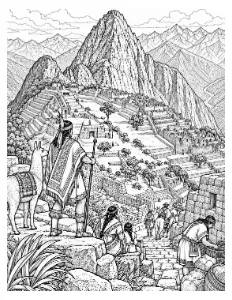
The Sapa Inca who began the great expansion of the Inca Empire. The chronicler Juan de Betanzos, who married an Inca noblewoman, recorded the Inca account that when the Chanka army attacked Cusco, the young prince Cusi Yupanqui defended the city, won the battle and became ruler, taking the name Pachacuti. During his reign the empire, Tawantinsuyu, spread across the Andes; Cusco was rebuilt with great stone temples and palaces; and royal estates, including Machu Picchu, were built. Listen for how he organised a growing empire.
More voices from this chapter
0:00
Topa Inca Yupanqui on his expansion and vision
Who they were
Topa Inca Yupanqui · Sapa Inca, r. 1471–1493
Pachacuti's son, who led Inca armies north into Ecuador and south into Chile, and brought the rich coastal kingdom of Chimor into the empire. The chronicler Pedro Sarmiento de Gamboa recorded an Inca account that he sailed with a fleet of rafts to islands in the Pacific. In the south, the Inca frontier was set at the Maule River, where the Mapuche held their land — the subject of chapter 14. Listen for how far the empire reached.
These are from Living History: Ancient America, Told By Those Who Were
There, which carries the same accounts in print.
Beyond the chapter
Additional Reading
The Inca built the largest empire in the Americas in under a century, without money, without markets, without writing as we define it, and without the wheel. How they did it is the interesting part.
Archaeologists measuring the fitted stone walls of Sacsayhuamán
The empire ran on labour and obligation rather than money. There was no currency and, in most of the empire, no marketplace. Instead there was the mit'a: every household owed the state a turn of labour — building roads, terracing hillsides, farming state land, serving in the army. In return the state fed people while they worked and kept great qollqa, storehouses, stocked against famine. The Spanish found these storehouses full; the soldier Pedro Cieza de León wrote of their number and of the cloth, food and weapons kept in them.
The roads held it together. The Qhapaq Ñan ran for tens of thousands of kilometres through desert, high plateau and cloud forest, with rope bridges over the gorges rewoven by the communities beneath them. One, the Q'eswachaka over the Apurímac, is still rebuilt every June by local families from grass rope — a bridge that has lasted five hundred years by being made new each year.
In the high Andes farmers made chuño by leaving potatoes out to freeze at night, treading the water out of them by day, and repeating it for days. Chuño keeps for years. At Moray the Inca built great circular terraces set into a hollow, where the temperature at the bottom and the top differs by many degrees, making a set of different growing conditions in one place.
At Sacsayhuamán above Cusco, blocks weighing many tons are fitted so closely that a knife blade will not go into the joint, with many-sided shapes rather than simple rectangles. When earthquakes have brought down colonial buildings in Cusco, the Inca walls beneath them have stood.
Four things worth knowing
There was no money in the Inca empire. Goods moved through labour owed, storage and redistribution.
The Inca ran a relay messenger service — chasquis at stations a few kilometres apart — who could carry a message about 250 miles in a day.
Moray's terraces differ in temperature from top to bottom, giving several growing climates in one hollow.
Inca surgeons performed trepanation — cutting an opening in the skull — and many skulls show the bone healed afterwards, so the patients lived.
Archaeologists measuring the fitted stone walls of Sacsayhuamán
The Inca built the largest empire in the Americas in under a century. They called it Tawantinsuyu, "the four parts together," because it was divided into four quarters that met at the capital, Cusco. They did it without money, without markets, without writing as we define it, and without the wheel. How they did it is the interesting part.
Work instead of money
The empire ran on labour and obligation rather than money. There was no currency, and in most of the empire there was no marketplace. Instead there was the mit'a, a labour tax: every household owed the state a turn of work — building roads, terracing hillsides, farming state land or serving in the army. In return the state fed people while they worked, and kept great storehouses, called qollqa, stocked against famine. The Spanish found these storehouses full. The soldier Pedro Cieza de León wrote of how many there were, and of the cloth, food and weapons kept in them.
The roads
The roads held the empire together. The Qhapaq Ñan, the royal road system, ran for tens of thousands of kilometres through desert, high plains and cloud forest. Rope bridges crossed the gorges, and the communities living beneath them rewove them. One, the Q'eswachaka over the Apurímac River, is still rebuilt every June by local families from grass rope. It is a bridge that has lasted five hundred years by being made new each year.
Farming in the mountains
In the high Andes farmers made chuño. They left potatoes out to freeze at night, trod the water out of them by day, and repeated this for several days. Chuño keeps for years. At Moray the Inca built great circular terraces — flat steps of farmland — set into a hollow in the ground. The temperature at the bottom and at the top differs by many degrees, which gave several different growing conditions in one place.
Stone that stands
At Sacsayhuamán, above Cusco, blocks weighing many tons are fitted so closely that a knife blade will not go into the joint. The stones are cut in many-sided shapes rather than simple rectangles, and no mortar holds them. When earthquakes have brought down Spanish colonial buildings in Cusco, the Inca walls beneath them have stood.
Four things worth knowing
There was no money in the Inca empire. Goods moved through labour owed, storage and handing out again.
The Inca ran a relay messenger service. Runners called chasquis waited at stations a few kilometres apart, and together could carry a message about 250 miles in a day.
The terraces at Moray differ in temperature from top to bottom, giving several growing climates in one hollow.
Inca surgeons performed trepanation — cutting an opening in the skull. Many skulls show that the bone healed afterwards, so the patients lived.
Archaeologists measuring the fitted stone walls of Sacsayhuamán
The Inca lived high in the Andes Mountains of South America. They called their land Tawantinsuyu, "the four parts together." Their capital city was Cusco. The Inca had no money, no iron and no wheels — and still built the biggest empire in the Americas.
People and their jobs
The Sapa Inca was the emperor, the one ruler over everyone.
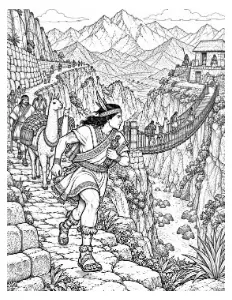
The chasqui was a runner. Runners waited at little stations along the road. Each one ran fast to the next station and passed on the message, like a relay race. Together they could carry a message about 250 miles in one day.
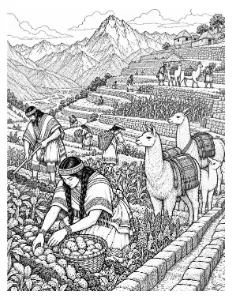
The farmer grew potatoes high up and maize lower down.
The mit'a worker. Instead of paying money, every family took a turn working for the state — building roads, farming, or serving in the army. The state fed them while they worked.
The stonemason shaped huge stones so they fit together without any mortar.
The bridge builder twisted grass into thick ropes to make bridges over deep river gorges.
The weaver made cloth. Fine cloth was stored in the storehouses and given by the ruler as a gift.
Animals
The llama carried loads along the mountain roads and gave wool and meat.
The alpaca gave soft wool for weaving.
The guinea pig was raised in houses for food.
Things they built and made
Roads. The great road, the Qhapaq Ñan, ran through deserts, mountains and cloud forests.
Rope bridges. One, the Q'eswachaka, is still rebuilt by local families every June.
Terraces are flat steps cut into the hillsides so that crops could grow on steep mountains.
Storehouses were stone buildings full of food, cloth and weapons, kept ready in case of hunger or war.
Chuño is a potato frozen at night and dried in the sun, again and again. It keeps for years.
Stone walls. At Sacsayhuamán the stones fit so tightly that a knife blade will not go between them.
Where this comes from. Everything on this page is drawn from the records of the time —
letters, logs, chronicles, codices and laws — and from what excavations have found. Where a
fact rests on a single account, the page names it.
Living books for Week 3 — South America
The Inca Empire, the Mapuche, and other South American tribes
The chapter taught on video — from the Adventure Box podcast series,
week 3 of Ancient America.
W4:D1 — The mysteries and controversies of the Inca empire
🎧 Podcast episode — Coming soon
From the Ultimate Guide — pages 166–174
Activity
Hands-on work from The Ultimate Ancient America Lesson Plan and
Activity Book. Pick one — you do not need to do all of them.
Building Machu Picchu with BlocksAges 8–14
Using irregular blocks — stones, or clay lumps — build a wall with no mortar that will not fall over when the table is shaken. Then look at photographs of real Inca ashlar joints.
Why it is worth doing. Students learn why mortarless Inca walls survive earthquakes that flatten mortared ones.
Objective
To understand Inca architecture and engineering skills, by constructing a model of Machu Picchu.
Materials Needed
Building blocks (such as LEGO or wooden blocks)
pictures of Machu Picchu
cardboard or baseplate for the model
Instructions
Show students pictures of Machu Picchu, and discuss its significance.
Provide building blocks, and encourage students to recreate Machu Picchu, using the pictures as a reference.
As they build, explain the purpose of the terraces, temples, and residential areas.
After completing the model, discuss the challenges the Incas might have faced in constructing such a city in the mountains.
Learning Outcome
Students will gain an appreciation for Inca architecture, and the complexity of building in challenging environments.
Inca Terraced Farming SimulationAges 8–14
Build terrace levels from cardboard in a container, fill with soil, plant seeds at different levels and water regularly. Observe growth over the following weeks.
Why it is worth doing. Students see terracing solve erosion, water and microclimate at once.
Objective
To understand the agricultural techniques used by the Incas, and the importance of terracing.
Materials Needed
Soil
seeds (such as beans or small plants)
containers (e.g., small pots or trays)
cardboard-to create terrace levels
Instructions
Discuss the importance of agriculture to the Inca civilization, and the concept of terraced farming.
Using cardboard, create terrace levels within a container.
Fill the terraces with soil, and plant seeds at different levels.
Water the plants regularly, and observe their growth over time.
Compare the growth of plants on different terrace levels, and discuss how terracing helps with water distribution and soil retention.
Learning Outcome
Students will learn about sustainable agricultural practices, and the importance of adapting farming techniques to the environment.
Inca Empire Map ActivityAges 10–15
Outline Tawantinsuyu on a map of South America, mark Cusco and the four quarters, and trace the Qhapaq Ñan. Measure its length against a modern road network.
Why it is worth doing. Students grasp the administrative problem the roads existed to solve.
Objective
To learn about the geography of the Inca Empire, and the extent of its territory.
Materials Needed
Blank maps of South America
markers or colored pencils
reference maps
showing the Inca Empire’s extent
Instructions
Provide students with blank maps of South America, and reference maps of the Inca Empire.
Have students outline the boundaries of the Inca Empire on their maps.
Mark important cities, roads (Qhapaq Ñan), and geographical features (Andes Mountains, Lake Titicaca).
Discuss the significance of the locations marked, and how geography influenced the development of the empire.
Learning Outcome
Students will develop an understanding of the geographical scope of the Inca Empire, and its strategic locations.
The Monthly Adventure Box ships
the craft kit for this era, so most of these arrive with the materials already cut.
Activity journal
Write about doing this activity. What did you actually make or do? What surprised you? What was harder than you expected, and what would you do differently next time? Then say one thing about Incan Civilization — Part 1 that you understand better now than you did before you started.
Saved on this device as you type. Send to my parent account submits it to the
Xogos parent/teacher grade page — you can keep editing and send again.
Extra
Do not have the book with you? These cover the same chapter, free, on
our blog — read them on a phone at a kitchen table or in the back of a car.
8 questions drawn from a pool of 16, plus one to
write in your own words. Open book — you are meant to look things up.
How this one works. You get four attempts. Each retake takes 5 points off
the top, never more than 20 — so a perfect paper passes however many tries it took. The
pass mark is 80%, and passing is what opens the next chapter. Every attempt draws
a different paper.
Sign in to take the exam
Your attempts, your score and your place in the course are kept on your
account, so the exam needs to know who you are.