This is the first of the book's two chapters on the Caribbean islands, and it begins thousands of years before 1492. The islands were settled in waves, and for almost all of that time the only record is what has been dug from the ground: stone and shell tools, heaps of shells, burials and broken pottery.
Archaeologists call the earliest islanders Casimiroid and Ortoiroid. They fished, gathered and hunted, and made no pottery. From about 500 BC the people archaeologists call Saladoid came up the island chain from the Orinoco River in South America, bringing painted pottery, clay griddles and cassava. Their descendants were the Taíno of the Greater Antilles. In the Lesser Antilles lived the Kalinago, whom the Spanish called Caribs.
The Living History chapter is told by Anacaona, the cacica of Xaragua, and by voices the book gives to a shaman of the canoe journeys, an elder of Caonabo's family, and Maboya, a Kalinago war chief.
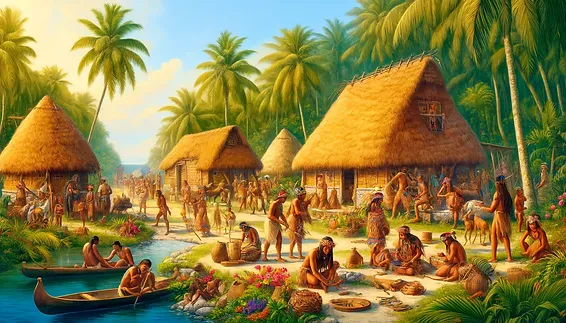
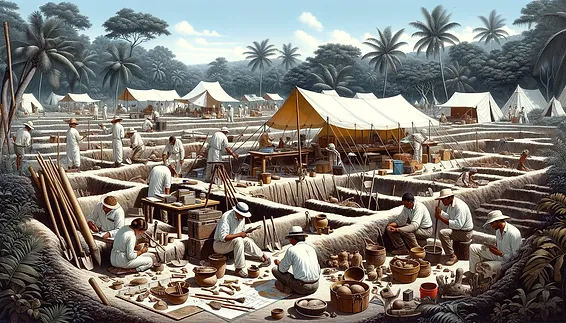
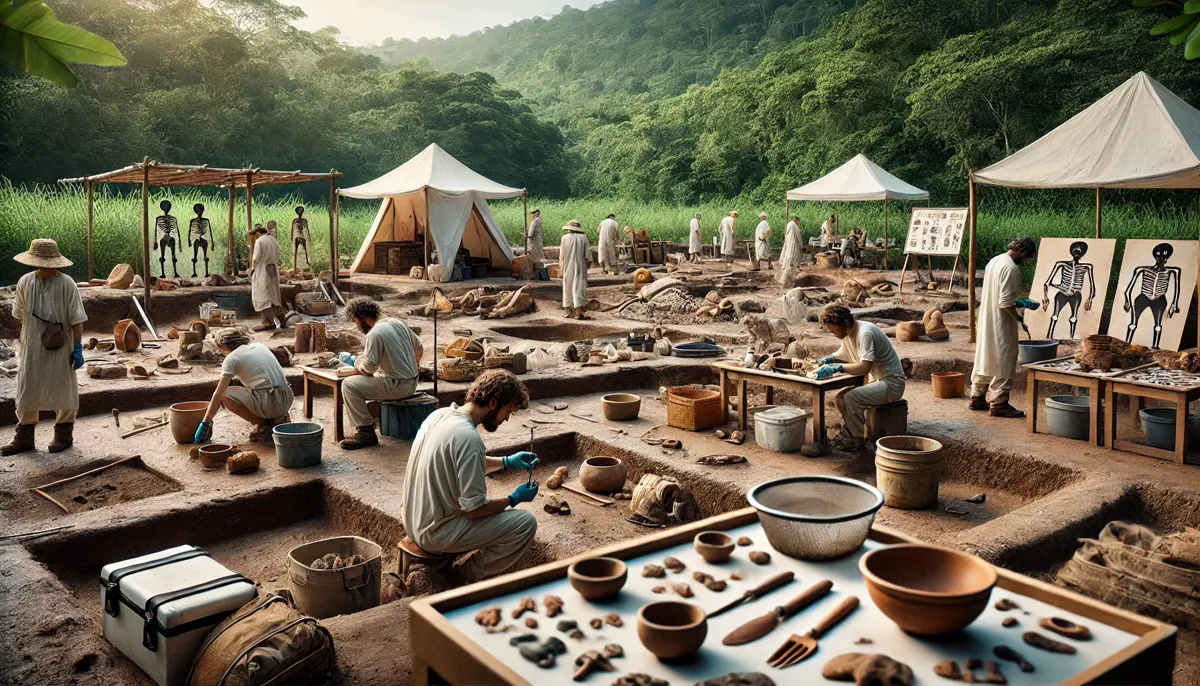
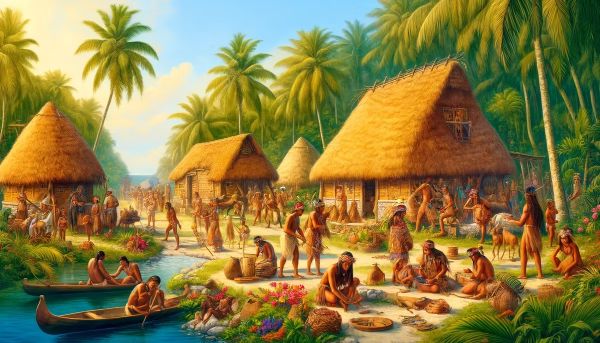
A Taíno village by the water, its dugout canoes at the bankExcavating a Caribbean site — the first islanders are known only from the groundArchaeologists recovering pottery and burials at a Taíno site
Look for these
The first islanders, as the excavations show them
Pottery, cassava and the canoe — what the Saladoid brought
The Taíno and the Kalinago on their islands
What this chapter teaches
Adaptability and resilience
Respect for nature and sustainable living
Valuing diversity and cultural exchange
The power of storytelling and oral tradition
Who you will meet
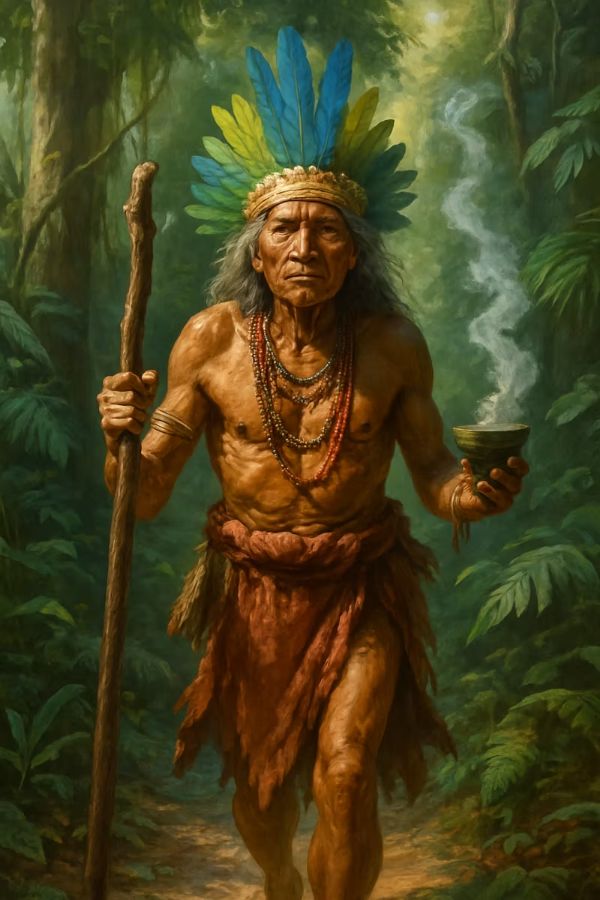
Yma Sumac's ancestorA shaman the book gives voice to, who tells of the canoe journeys from the Orinoco — page 252
AnacaonaCacica of Xaragua, poet and keeper of the areítos — page 255
Caonabo's elderA keeper of memory, who tells of the first islanders — page 257
MaboyaWar chief of the Kalinago of Waitukubuli (Dominica) — page 259
While this was happening in the Americas, these were happening everywhere else.
The Ubaid culture of southern Mesopotamia
c. 5500 – 4000 BC
The Sahara dries and farming villages spread along the Nile
c. 6000 – 5000 BC
The first cities of Mesopotamia
c. 3500 BC
The Olmec of Mexico
c. 1500 – 400 BC
Norse voyages to North America
c. 1000 AD
How to use this lesson. Read the chapter first — then work across the tabs in
order. The music hands you the era in a song, the subject matter expert puts a face to the
history, the reading takes you past the chapter, the video teaches it, the activity puts it
in your hands, and the exam at the end is how you check it stuck.
Read first
pages 184–202 —
The History of Ancient America: Ultimate Guide to Learning, the lesson plan and
activity book. This is where the activity on tab six comes from.
pages 252–267 —
Living History: Ancient America, Told By Those Who Were There, where the people
on the Subject Matter Expert tab tell it themselves.
The Music of This Era
Nothing sticks like a song. Written for this chapter, and worth having on while you do the activity.
Listen for the details. A specialist tells the story as someone who was there. The
things they mention in passing — what they ate, how they travelled, what they made, who
ruled them — are the details worth writing down.
Heroes & Villains — told in the first person
Anacaona, a Taíno cacica
Anacaona tells her story on the island of Quisqueya
0:00
Who they were
Anacaona · Taíno cacica of Xaragua, d. c. 1504
A Taíno cacica, a woman ruling in her own right, and a composer of areítos, the songs and dances that told her people's history. She was the sister of Bohechío, the cacique of Xaragua on Hispaniola, and the wife of the cacique Caonabo, and she governed Xaragua after her brother's death. The chronicles of Bartolomé de las Casas and Gonzalo Fernández de Oviedo record that in 1503 the governor Nicolás de Ovando came to Xaragua, where she received him with a great welcome; that Ovando had the gathered chiefs killed; and that Anacaona was taken to Santo Domingo and hanged. She is honoured today in Haiti and the Dominican Republic. Listen for her description of the areítos.
More voices from this chapter
0:00
Diego Chanca on the Taíno and the Caribs, from Columbus's second voyage
Who they were
Diego Álvarez Chanca · Physician on Columbus's second voyage, 1493
A physician from Seville in the service of King Ferdinand and Queen Isabella, who appointed him to sail as the doctor of Christopher Columbus's second voyage. The fleet of seventeen ships left Cádiz on 25 September 1493. Chanca's letter to the city council of Seville is the earliest written description of the Caribbean islands by a member of the expedition: he described Dominica and Guadeloupe, the plants and animals, the bread the Taíno made from cassava root, and their villages and customs. At Guadeloupe, his letter records, Taíno women and boys who had been carried off from other islands as captives came to the Spaniards for protection and were taken aboard the ships, and they told Columbus's men about their own islands. Chanca was with Columbus when the fleet reached La Navidad on Hispaniola, and he cared for the sick at the new settlement of La Isabela. Listen for what he learned about the Taíno and how the captives were brought to safety.
These are from Living History: Ancient America, Told By Those Who Were
There, which carries the same accounts in print.
Beyond the chapter
Additional Reading
The Taíno and Kalinago were the first peoples of the Americas described in writing by Europeans — by Columbus, by the physician Diego Álvarez Chanca, and by the friars who came after them. But the islands had been lived on for thousands of years before any of them arrived.
Excavating a Caribbean site — the first islanders are known only from the ground
The oldest part of the story is known only from excavation. At Banwari Trace in Trinidad, archaeologists found heaps of shells and a human burial about seven thousand years old, among the oldest in the Caribbean. The earliest islanders are named after the places their tools were first identified — Casimiroid after Casimira in the Dominican Republic, Ortoiroid after Ortoire in Trinidad. They left stone and shell tools and middens, heaps of the shells and bones of their meals, and no pottery.
Pottery came with the people archaeologists call Saladoid, named after Saladero, a site on the lower Orinoco River in Venezuela. From about 500 BC they moved up the island chain as far as Puerto Rico and Hispaniola. Their pottery is painted white on red, and among it are flat clay griddles of the kind the Taíno later used to bake cassava bread. The Taíno whom Columbus met were their descendants.
The Taíno lived in villages under caciques — a title that could be held by women — with a central plaza and a batey ball court. They farmed cassava on mounded fields called conucos, which drained well and held moisture, and they carved zemis, figures of the spirits they honoured. Columbus's log for 13 October 1492 describes their canoes, each cut from a single tree trunk, some holding one man and some forty or forty-five. The friar Ramón Pané, who lived among the Taíno of Hispaniola from 1494, wrote down their beliefs and stories — the first book written in the Americas by a European.
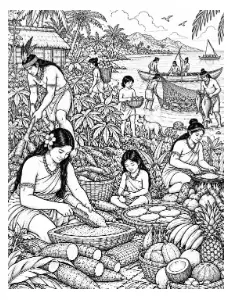
Cassava fed the islands. Gonzalo Fernández de Oviedo, who lived on Hispaniola and published his General and Natural History of the Indies in 1535, describes the bitter root, whose juice is a deadly poison. It was grated, the pulp squeezed in a long woven press, the cibucán, and the dry flour baked on a clay griddle into round, flat loaves of cassava bread.
The Kalinago of the Lesser Antilles were described at length by French missionaries in the 1600s. Raymond Breton, who lived among them on Dominica, published a Carib–French dictionary in 1665. He and Charles de Rochefort, whose history of the Antilles appeared in 1658, record that Kalinago men and women used different words for many things. Rochefort gives the Kalinago's own account of why: their ancestors had come from the mainland, killed the men of the people who held the islands before them, and kept the women, who went on speaking their own language.
The islanders' words are in everyday English: hurricane, canoe, barbecue, hammock, tobacco, maize, iguana, cassava, savanna. A genetic study in Puerto Rico in 2003 found Native American mitochondrial DNA in about 61% of the people sampled. Taíno and Kalinago identity is kept today, and the Kalinago Territory in Dominica has its own chief.
Four things worth knowing
Hurricane comes from huracán, a Taíno word for the great storm. It entered English through Spanish.
Columbus's log describes the islanders' beds as nets of cotton. The Taíno word was hamaca — our hammock.
Borikén was the Taíno name for Puerto Rico. Puerto Ricans still call themselves Boricua.
Taíno ball courts at Caguana in Puerto Rico are still standing, bordered by carved stone slabs.
Excavating a Caribbean site — the first islanders are known only from the ground
The Caribbean islands were settled thousands of years before 1492. The book traces the peoples who came, one after another, and the Taíno way of life that grew out of them. The Taíno and their neighbours were also the first peoples of the Americas described in writing by Europeans — by Christopher Columbus, by the physician Diego Álvarez Chanca, and by the friars who came after them.
The first islanders
According to the book, the first known people in the Caribbean, called the Ciboney or Guanahatabey, settled in Cuba and other islands around 5000 BC. They were hunter-gatherers: they hunted animals and gathered plants, and lived in small groups that moved from place to place. In the Archaic Age (about 4000–200 BC) other groups arrived, which archaeologists call the Casimiroid and Ortoiroid. They brought polished stone tools and better ways of fishing. What they left behind — stone scrapers and blades, tools in caves and rock shelters, and great heaps of discarded shells called shell middens — shows how much they lived from the sea.
The Ceramic Age
Pottery reached the islands around 500 BC. The book calls this the start of the Ceramic Age. The Saladoid people came from the Orinoco River, in what is now Venezuela, and settled on islands such as Puerto Rico, the Virgin Islands and Hispaniola, which its people called Ayiti. They were farmers and potters, known for ceramics painted white on red. By around 1000 AD their descendants, the Taíno, had become the main people of the Greater Antilles — Cuba, Jamaica, Hispaniola and Puerto Rico.
How the Taíno lived
The Taíno lived in villages under leaders called caciques, a title that could be held by women. Each village had a central plaza and a batey, a ball court. They farmed cassava on mounded fields called conucos, which drained well and held moisture. They carved zemis, figures of the spirits they honoured. Columbus's log for 13 October 1492 describes their canoes, each cut from a single tree trunk, some holding one man and some forty or forty-five. The friar Ramón Pané, who lived among the Taíno of Hispaniola from 1494, wrote down their beliefs and stories. It was the first book written in the Americas by a European.
Their words live on
Taíno words are part of everyday English: hurricane, canoe, barbecue, hammock, tobacco, maize, iguana, cassava, savanna. A genetic study in Puerto Rico in 2003 found Native American ancestry, passed down through mothers, in about 61% of the people sampled. Taíno and Kalinago identity is kept today, and the Kalinago Territory in Dominica has its own chief.
Two things worth knowing
Hurricane comes from huracán, a Taíno word for the great storm. It came into English through Spanish.
Taíno ball courts at Caguana in Puerto Rico are still standing, lined with carved stone slabs.
Excavating a Caribbean site — the first islanders are known only from the ground
The Caribbean is a sea full of islands between North and South America. People lived on these islands for thousands of years before any ship came from Europe.
The first islanders
The book tells us the first known people reached Cuba and the nearby islands around 5000 BC. Later groups came, too. They did not farm much. They hunted, fished and gathered shellfish.
The toolmaker made scrapers, blades and points from stone, bone and shell.
The shell gatherer collected clams and other shellfish. Archaeologists find big piles of their old shells, called shell middens.
Caves and rock shelters were places where they stayed, and left their tools behind.
The canoe people
Around 500 BC new people paddled north from the Orinoco River in South America, where Venezuela is now. They settled on islands like Puerto Rico and Hispaniola. The Taíno people came from them.
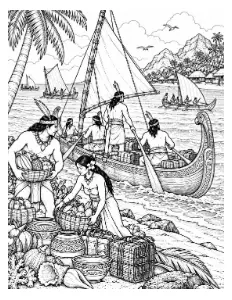
The canoe maker hollowed out a whole tree trunk to make a canoe. Some canoes held one person. Some held forty.
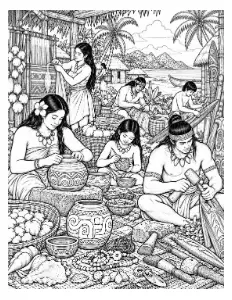
The potter made pots painted with white designs on red.
The farmer grew cassava, maize and sweet potatoes on round mounds of earth called conucos.
The carver made zemis — figures of stone, wood or shell that stood for the spirits the people honoured.
The singer led the areíto, a song and dance that told the people's stories.
Animals
Fish and shellfish came from the sea all around.
The iguana is a big lizard. "Iguana" is a Taíno word.
Things we still use
We still use many of their words: canoe, hammock, hurricane, barbecue and cassava. A hammock was the bed they slept in, hung between two posts.
Where this comes from. Everything on this page is drawn from the records of the time —
letters, logs, chronicles, codices and laws — and from what excavations have found. Where a
fact rests on a single account, the page names it.
The chapter taught on video — from the Adventure Box podcast series,
week 4 of Ancient America.
W4:D2 — Who did Columbus meet when he came to the Americas?
🎧 Podcast episode — Coming soon
From the Ultimate Guide — pages 184–202
Activity
Hands-on work from The Ultimate Ancient America Lesson Plan and
Activity Book. Pick one — you do not need to do all of them.
Artifact Replication ActivityAges 8–14
Carve or model a zemi from soap or clay, copying a real Taíno example. Research what that particular zemi represented before you start.
Why it is worth doing. Students learn that the form of a religious object carries specific meaning.
Objective
Understand the types of artifacts used by Caribbean tribes.
Materials Needed
Clay or playdough
Crafting tools (toothpicks, plastic knives, etc.)
Paints and brushes
Reference images of artifacts (pottery, zemís, tools)
Instructions
Introduction : Begin with a brief introduction to the different types of artifacts found in Caribbean archaeological sites. Show students images of pottery, zemís, and tools.
Crafting : Provide students with clay or playdough, and tools. Ask them to choose an artifact to replicate. They can shape and carve the clay to mimic the original artifact.
Painting : Once the clay has dried, students can paint their artifacts to match the colors and patterns of the originals.
Presentation : Have students present their artifacts to the class, explaining what they learned about the object, and its cultural significance.
Learning Outcome
Students learn that the form of a religious object carries specific meaning.
Cooking Traditional FoodsAges 10–15
Prepare and taste foods the islanders grew and caught — cassava, sweet potatoes, maize and fish. First talk through how the Taíno grated bitter cassava and pressed out its poisonous juice before baking the flour into bread. (Use shop-bought sweet cassava, sold as yuca, and cook it thoroughly.)
Why it is worth doing. Students learn the diet and farming of the islands, and why cassava needed such careful preparation.
Objective
Learn about the diet and agricultural practices of Caribbean tribes.
Materials Needed
Ingredients for traditional recipes (cassava, sweet potatoes, maize, fish, etc.)
Cooking utensils and equipment
Recipe cards, with historical context
Instructions
Introduction : Begin with a discussion about the traditional foods and agricultural practices of the Caribbean tribes. Explain the significance of staple crops, like cassava and maize.
Cooking : Divide students into small groups, and assign each group a recipe to prepare. Provide ingredients and supervise as they follow the recipe cards.
Tasting and Discussion : Once the food is prepared, have a tasting session. Encourage students to share their thoughts on the flavors and textures.
Learning Outcome
Students learn the diet and farming of the islands, and why cassava needed such careful preparation.
Words That SurvivedAges 8–14
Track down the everyday English words that came from Taíno — hurricane, canoe, barbecue, hammock, tobacco, maize, potato, iguana. Find where each entered English.
Why it is worth doing. Students find living evidence that a people described as 'extinct' is still with us daily.
Objective
To trace the everyday English words that came from Taíno, and where each one entered the language.
Instructions
Track down the everyday English words that came from Taíno — hurricane, canoe, barbecue, hammock, tobacco, maize, potato, iguana.
Find where each one entered English.
Learning Outcome
Students find living evidence that a people described as 'extinct' is still with us daily.
The Monthly Adventure Box ships
the craft kit for this era, so most of these arrive with the materials already cut.
Activity journal
Write about doing this activity. What did you actually make or do? What surprised you? What was harder than you expected, and what would you do differently next time? Then say one thing about Caribbean Tribes and Cultures — Part 1 that you understand better now than you did before you started.
Saved on this device as you type. Send to my parent account submits it to the
Xogos parent/teacher grade page — you can keep editing and send again.
Extra
Do not have the book with you? These cover the same chapter, free, on
our blog — read them on a phone at a kitchen table or in the back of a car.
8 questions drawn from a pool of 16, plus one to
write in your own words. Open book — you are meant to look things up.
How this one works. You get four attempts. Each retake takes 5 points off
the top, never more than 20 — so a perfect paper passes however many tries it took. The
pass mark is 80%, and passing is what opens the next chapter. Every attempt draws
a different paper.
Sign in to take the exam
Your attempts, your score and your place in the course are kept on your
account, so the exam needs to know who you are.