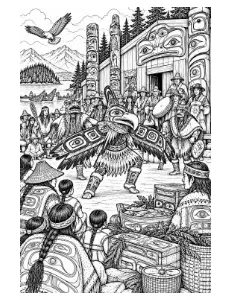
The Pacific Northwest breaks one of the oldest rules in history teaching: that complex, wealthy, stratified societies require agriculture. The peoples of this coast — Haida, Tlingit, Kwakwaka'wakw, Coast Salish and others — built exactly such societies on salmon, cedar and the sea.
The salmon run made it possible. A resource that arrives in overwhelming quantity at a predictable time can be preserved and stored, and storage is what lets people stay in one place, accumulate, specialise and build. Cedar supplied everything else: plank houses, ocean-going canoes, boxes, clothing and the great carved poles.
Wealth here was displayed by giving it away. The potlatch — a feast at which a host distributed enormous quantities of goods before invited guests — established rank, conferred names and marked marriages, deaths and the raising of poles. Canada made it an offence under the Indian Act from 1885 until 1951.
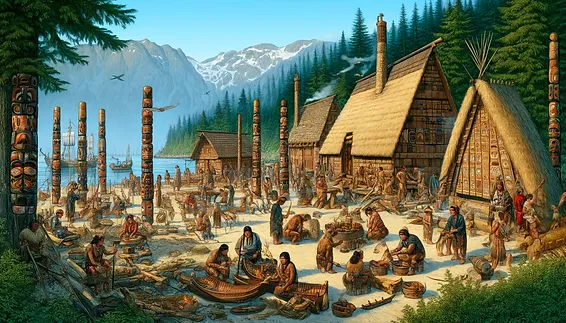
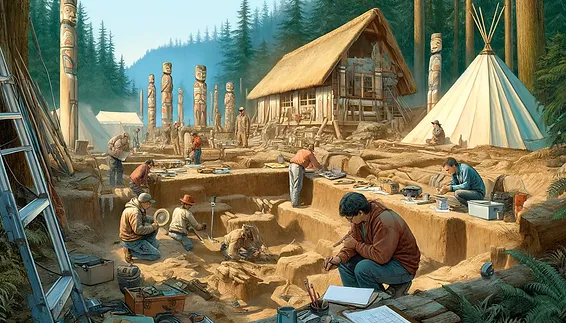
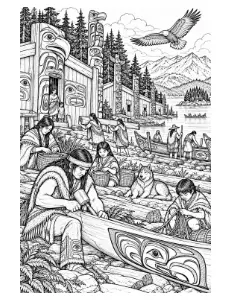
A Northwest Coast villageExcavating a Northwest Coast site
Look for these
Abundance without agriculture
Art as a record of lineage and rights, not decoration
Wealth measured by what you give away
What this chapter teaches
The importance of social cohesion and hierarchy
The power of ceremonial practices
Living in harmony with nature
Resourcefulness and adaptation
The role of art in cultural expression
Preserving cultural heritage
Effective leadership and diplomacy
Resilience in the face of adversity
Words this chapter introduces
potlatchtotem poleplank housecedarHaidaTlingitsalmon run
Meanwhile, elsewhere in the world
While this was happening in the Americas, these were happening everywhere else.
Merimde Beni-Salame, a farming village in the Nile Delta
c. 5000 BC
The Ubaid culture of southern Mesopotamia
c. 5500 – 4000 BC
The Yangshao culture along the Yellow River in China
c. 5000 – 3000 BC
The first cities of Mesopotamia — Uruk and Eridu
c. 4000 – 3000 BC
How to use this lesson. Read the chapter first — then work across the tabs in
order. The music hands you the era in a song, the subject matter expert puts a face to the
history, the reading takes you past the chapter, the video teaches it, the activity puts it
in your hands, and the exam at the end is how you check it stuck.
Read first
pages 75–87 —
The History of Ancient America: Ultimate Guide to Learning, the lesson plan and
activity book. This is where the activity on tab six comes from.
pages 58–74 —
Living History: Ancient America, Told By Those Who Were There, where the people
on the Subject Matter Expert tab tell it themselves.
The Music of This Era
Nothing sticks like a song. Written for this chapter, and worth having on while you do the activity.
Listen for the details. A specialist tells the story as someone who was there. The
things they mention in passing — what they ate, how they travelled, what they made, who
ruled them — are the details worth writing down.
Heroes & Villains — told in the first person
Chief Skidegate of the Haida
Chief Skidegate tells his story, and of the first European and Asian visitors
0:00
Who they were
Chief Skidegate · Haida, Haida Gwaii
Skidegate is a hereditary chiefly title of the Haida, and the village of HlG̱aagilda Skidegate on Haida Gwaii carries the name of the chiefs who held it. Chiefs of this line met the first European and American trading ships to reach the Northwest Coast in the late 1700s, and the Haida became leading partners in the sea-otter fur trade that followed. Haida towns were known for their cedar plank houses, carved crest poles and large ocean-going canoes. After the smallpox epidemic of 1862, people from many Haida villages came together to live at Skidegate and Masset. Listen for how he describes trading with the ships that arrived on his coast.
More voices from this chapter
0:00
Chief Shakes of the Tlingit Nation on his role as chief
Shakes is a hereditary title held in succession by the chiefs of the Naanyaa.aayí clan at Wrangell in southeast Alaska — Shakes I through VII, across the fur-trade era and the Russian and American periods. A chief on this coast was the keeper of a house's names, crests, songs and territories, which he held on behalf of the clan, and he showed his standing by giving gifts to guests at the potlatch. The Chief Shakes Tribal House still stands on Shakes Island at Wrangell. Listen for what a chief was responsible for.
These are from Living History: Ancient America, Told By Those Who Were
There, which carries the same accounts in print.
Beyond the chapter
Additional Reading
The peoples of the Northwest Coast built rich, ranked societies on salmon and cedar, and recorded their histories in carving, crests and the great feasts called potlatches.
Excavating a Northwest Coast site
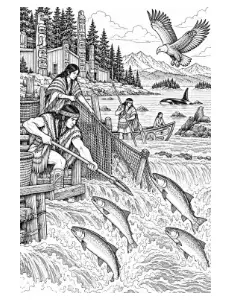
Five species of salmon run up the rivers of this coast in great numbers at predictable times each year. Dried and smoked, they keep for a year. That stored food let the Haida, Tlingit, Kwakwaka'wakw and their neighbours live in permanent villages of great plank houses, with hereditary chiefs and nobles, commoners and slaves, and carvers and painters who worked at their craft full time.
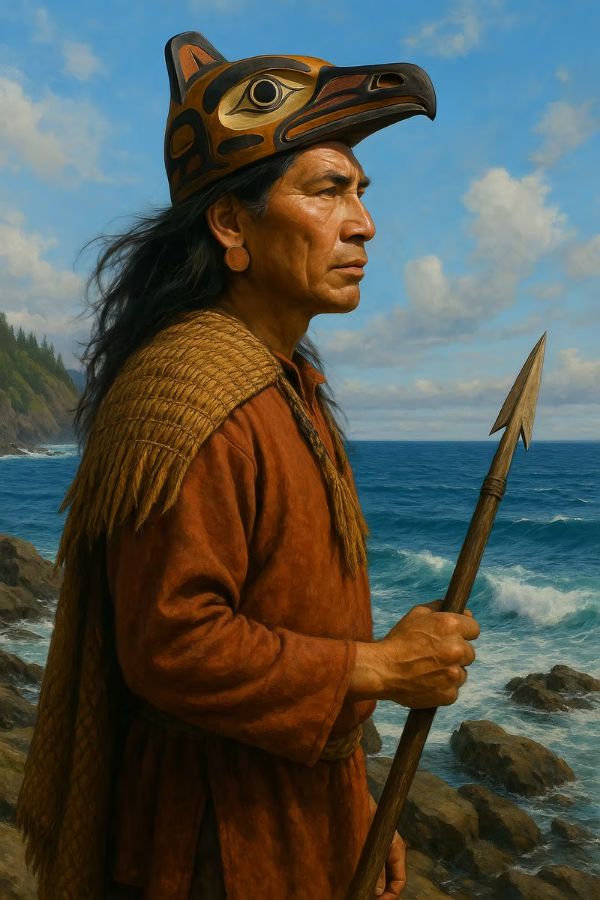
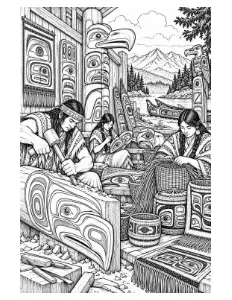
Their art follows rules. Formline design is built from a few shapes — the ovoid, the U-form and the S-form — joined in flowing lines, and a Haida artist and a Tlingit artist a hundred miles apart worked in one shared visual language. A crest carved on a house post or painted on a bentwood box declared a family's descent and the rights it had inherited: the right to a name, a song, a dance or a fishing place.
Those rights were confirmed at the potlatch, where a host gave gifts to invited guests, who witnessed the names given, the marriages recognised, the debts repaid and the family histories told. Canada made the potlatch an offence under the Indian Act from 1885; missionaries and Indian agents had reported the feasts as wasteful and as keeping people from the settled farming and schooling the government wanted. Families went on holding them in secret. In 1921, after a potlatch given by Dan Cranmer at Village Island, forty-five people were charged and their regalia was taken to museums. The ban was dropped in 1951, and much of the regalia was returned in the 1970s and 1980s to the U'mista Cultural Centre at Alert Bay and the Nuyumbalees Centre on Quadra Island.
The bentwood box shows the same skill in a small thing. A single cedar plank is grooved across the grain in three places, steamed until it bends, folded into four sides, pegged or sewn at the last corner, and fitted with a base. It holds water, and food can be cooked in it with hot stones. One plank, three folds, no nails.
Four things worth knowing
A large plank house could hold several families. Its planks could be lifted off the frame, carried by canoe to a summer fishing camp, and put back up there.
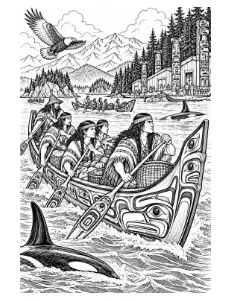
Ocean-going canoes were carved from a single red cedar, then filled with hot water and stones so the softened sides could be spread wider.
Cedar bark was pounded soft enough to weave into clothing, blankets and mats. One tree supplied houses, boats, boxes and cloth.
Carved poles were traditionally left to weather and in time fall, and a new pole might be raised in its place.
Excavating a Northwest Coast site
The peoples of the Northwest Coast — among them the Haida, Tlingit, Kwakwaka'wakw and Coast Salish — built rich, ranked societies on salmon and cedar. They recorded their histories in carving, in crests and in the great feasts called potlatches.
Salmon and cedar
Five species of salmon run up the rivers of this coast in great numbers at predictable times each year. Dried and smoked, they keep for a year. That stored food let people live in permanent villages of great plank houses. Society was ranked: there were hereditary chiefs and nobles, commoners and slaves, and carvers and painters who worked at their craft full time.
The red cedar supplied almost everything else. Cedar bark was pounded soft enough to weave into clothing, blankets and mats. Ocean-going canoes were carved from a single tree, then filled with hot water and stones so the softened sides could be spread wider. A large plank house could hold several families. Its planks could be lifted off the frame, carried by canoe to a summer fishing camp, and put back up there. One tree supplied houses, boats, boxes and cloth.
Art with rules
Their art follows rules. Formline design is built from a few shapes — the ovoid (a rounded rectangle), the U-form and the S-form — joined in flowing lines. A Haida artist and a Tlingit artist a hundred miles apart worked in one shared visual language.
A crest carved on a house post or painted on a box declared a family's descent and the rights it had inherited: the right to a name, a song, a dance or a fishing place. Carved poles were traditionally left to weather and, in time, to fall, and a new pole might be raised in the old one's place.
The potlatch
Those rights were confirmed at the potlatch. A host gave gifts to invited guests, and the guests acted as witnesses. They saw the names given, the marriages recognised, the debts repaid and the family histories told.
Canada made the potlatch an offence under the Indian Act from 1885. Missionaries and Indian agents had reported the feasts as wasteful, and as keeping people from the settled farming and schooling the government wanted. Families went on holding them in secret. In 1921, after a potlatch given by Dan Cranmer at Village Island, forty-five people were charged, and their regalia — ceremonial masks, clothing and objects — was taken to museums. The ban was dropped in 1951. Much of the regalia was returned in the 1970s and 1980s to the U'mista Cultural Centre at Alert Bay and the Nuyumbalees Centre on Quadra Island.
The bentwood box
The bentwood box shows the same skill in a small thing. A single cedar plank is grooved across the grain in three places and steamed until it bends. It is folded into four sides, pegged or sewn at the last corner, and fitted with a base. It holds water, and food can be cooked in it with hot stones. One plank, three folds, no nails.
Excavating a Northwest Coast site
The Northwest Coast runs along the Pacific Ocean, from Alaska down to Washington. It is a land of tall cedar trees and rivers full of fish. The Haida, Tlingit, Kwakwaka'wakw and Coast Salish are some of the peoples who live there.
People in the village
Chiefs led the village. The job passed down in families.
Noble families owned special rights: a name, a song, a dance, or a place to fish.
Fishers caught salmon with nets, traps and hooks.
Carvers made house posts, poles, masks, boxes and canoes. Some carvers and painters did this as their full-time work.
Weavers made clothing, blankets and mats from soft cedar bark.
Canoe makers carved big boats from a single cedar tree.
Hosts and guests came together at a feast called a potlatch. The host gave gifts, and the guests watched as names were given and family stories were told.
Animals
Salmon — five kinds swim up the rivers every year. Dried and smoked, salmon kept for a whole year.
Halibut and shellfish — food from the sea.
Deer and elk — hunted in the forest.
Raven and Eagle — among the Haida, every family belongs to one of these two sides.
Things they made
Plank house — a big wooden house for several families. The planks could be taken down and carried by canoe to a summer fishing camp.
Cedar canoe — carved from one tree, then filled with hot water and hot stones so the sides grew soft and could be spread wider.
Bentwood box — one cedar plank, steamed and bent into four sides. It could hold water, and food could be cooked in it with hot stones.
Carved poles and house posts — covered with crests, the animal pictures that told which family you came from.
Masks — worn for dances and ceremonies.
At Ozette, in Washington, mud once covered part of a Makah village. When archaeologists dug there, starting in 1970, they found houses, wooden tools, baskets and fishing gear, still in good shape after hundreds of years.
Where this comes from. Everything on this page is drawn from the records of the time —
letters, logs, chronicles, codices and laws — and from what excavations have found. Where a
fact rests on a single account, the page names it.
Living books for Week 1 — North America
Arctic peoples, Adena and Hopewell, Poverty Point, Great Basin, Plateau, and Northwest Coast cultures
The chapter taught on video — from the Adventure Box podcast series,
week 1 of Ancient America.
W2:D3 — Northwest Coastal cultures: escaping the cold
🎧 Podcast episode — Coming soon
From the Ultimate Guide — pages 75–87
Activity
Hands-on work from The Ultimate Ancient America Lesson Plan and
Activity Book. Pick one — you do not need to do all of them.
Design a Family Crest PoleAges 8–14
Research the meaning of common Northwest Coast crest figures — raven, eagle, bear, killer whale, frog. Then design a pole that records your own family's story, stacking the figures in a deliberate order, and explain each choice.
Why it is worth doing. Students learn that a crest pole is a record of lineage and rights, not an idol.
Objective
Totem poles are iconic symbols of Northwest Coast cultures, depicting clan lineages, historical events, and spiritual stories.
Materials Needed
Cardboard tubes or paper towel rolls
Colored paper, markers, and paint
Glue and scissors
Optional: clay for sculpting
Instructions
Research : Begin by showing students images of traditional totem poles and discussing their significance. Explain the meanings behind different animal symbols and figures.
Design : Have students sketch their totem pole designs on paper. They should choose figures that represent their own personal or family stories.
Create : Students can then use cardboard tubes or paper towel rolls as the base. They can cut out shapes from colored paper or use markers and paint to decorate their totem poles.
Share : Once completed, allow students to present their totem poles , and explain the stories behind their designs.
Learning Outcome
Students learn that a crest pole is a record of lineage and rights, not an idol.
Hold a PotlatchAges 10–15
Each student brings a small item to give away. Hosts must give away more than they receive, and announce why each gift is made. Afterwards, discuss how status worked here, and why both Canada and the United States banned it.
Why it is worth doing. Students experience an economy where giving, not hoarding, creates standing.
Objective
The potlatch ceremony was a central cultural practice among Northwest Coast people, involving feasting, dancing, and the redistribution of wealth.
Materials Needed
Costumes or simple props (optional)
Printed scripts or role descriptions
Fake money or tokens
Instructions
Introduction : Explain the potlatch ceremony and its significance. Discuss the roles of the host, guests, and the types of gifts exchanged.
Assign Roles : Assign students different roles, such as the chief, family members, and guests. Provide them with simple scripts or role descriptions to guide their actions.
Role-Play : Conduct a mock potlatch ceremony. The host can distribute fake money or tokens to the guests while everyone enjoys a simulated feast and performs traditional dances or songs.
Discussion : After the role-play, discuss the experience with the students. Ask them how they felt about giving and receiving gifts and the importance of community in the potlatch ceremony.
Learning Outcome
Students experience an economy where giving, not hoarding, creates standing.
The Monthly Adventure Box ships
the craft kit for this era, so most of these arrive with the materials already cut.
Activity journal
Write about doing this activity. What did you actually make or do? What surprised you? What was harder than you expected, and what would you do differently next time? Then say one thing about Northwest Coast Cultures that you understand better now than you did before you started.
Saved on this device as you type. Send to my parent account submits it to the
Xogos parent/teacher grade page — you can keep editing and send again.
Extra
Do not have the book with you? These cover the same chapter, free, on
our blog — read them on a phone at a kitchen table or in the back of a car.
8 questions drawn from a pool of 16, plus one to
write in your own words. Open book — you are meant to look things up.
How this one works. You get four attempts. Each retake takes 5 points off
the top, never more than 20 — so a perfect paper passes however many tries it took. The
pass mark is 80%, and passing is what opens the next chapter. Every attempt draws
a different paper.
Sign in to take the exam
Your attempts, your score and your place in the course are kept on your
account, so the exam needs to know who you are.