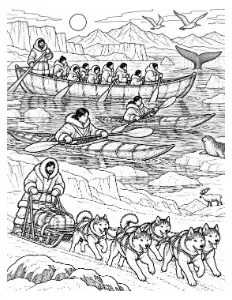
The Arctic is the hardest place on the continent to live, and people have lived there for thousands of years. This chapter is about the cultures of the far north — the Paleo-Eskimo traditions, the Dorset, and the Thule people who are the direct ancestors of today's Inuit.
What makes the Arctic story remarkable is not endurance but engineering. Without metal, and with almost no wood, Arctic peoples built the kayak and the umiak, the toggling harpoon, snow goggles, the dog sled and tailored waterproof clothing — solutions so well-suited to the problem that modern equipment still copies them.
The Thule expansion is one of the fastest cultural spreads in the ancient Americas: a people with better boats and better hunting technology moved east across the top of the continent, from Alaska to Greenland, in a few centuries.
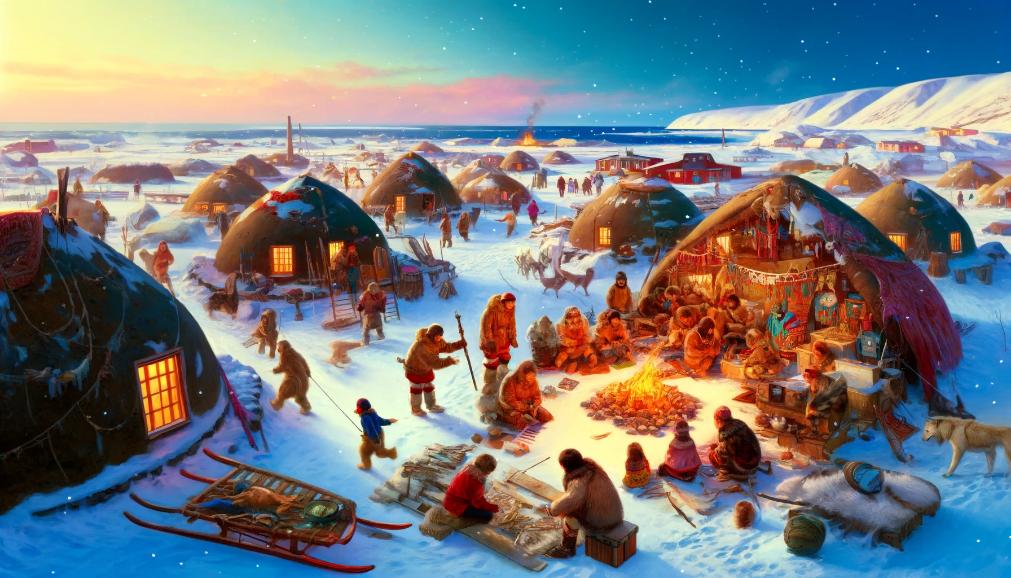
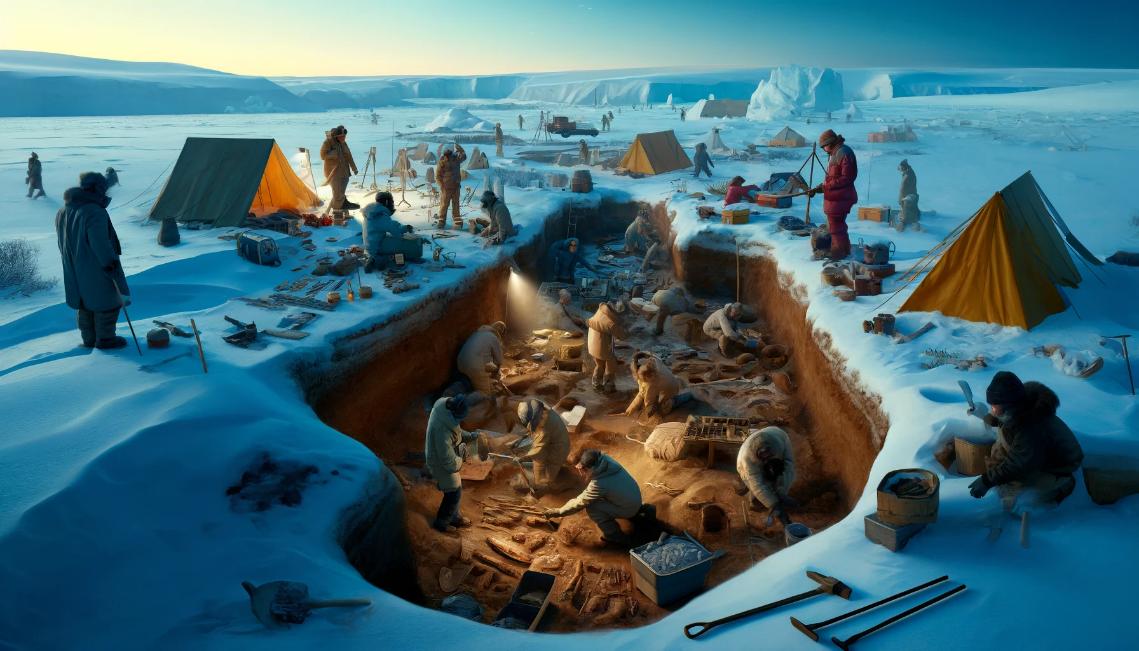
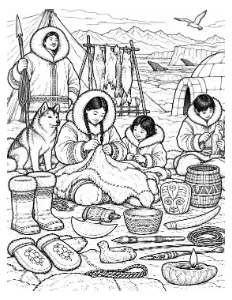
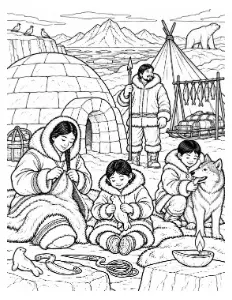
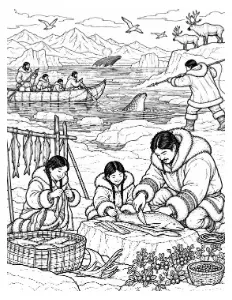
An Arctic camp on the sea iceExcavating an Arctic site
Look for these
Technology as survival, not convenience
What it means to build everything from animals when there are no trees
How the Thule spread across the whole American Arctic
What this chapter teaches
Skill passed from hand to hand
Leadership by competence, not birth
Who you will meet
ShamansSpiritual leaders and healers
Master toolmakersThe people who made survival possible
Community leadersWho decided when and where to move
Skilled huntersOn whom everyone depended
Words this chapter introduces
ThuleDorsetumiakkayaktoggling harpoonSubarctic
Meanwhile, elsewhere in the world
While this was happening in the Americas, these were happening everywhere else.
The Harappan Civilization
c. 3300 – 1300 BC
The Egyptian Middle Kingdom
c. 2055 – 1650 BC
The Xia Dynasty
c. 2070 – 1600 BC
The sarsen circle raised at Stonehenge
c. 2500 BC
The Viking Age, when Norse ships reached the Arctic
c. 793 – 1066 AD
How to use this lesson. Read the chapter first — then work across the tabs in
order. The music hands you the era in a song, the subject matter expert puts a face to the
history, the reading takes you past the chapter, the video teaches it, the activity puts it
in your hands, and the exam at the end is how you check it stuck.
Read first
pages 53–64 —
The History of Ancient America: Ultimate Guide to Learning, the lesson plan and
activity book. This is where the activity on tab six comes from.
pages 21–39 —
Living History: Ancient America, Told By Those Who Were There, where the people
on the Subject Matter Expert tab tell it themselves.
The Music of This Era
Nothing sticks like a song. Written for this chapter, and worth having on while you do the activity.
Listen for the details. A specialist tells the story as someone who was there. The
things they mention in passing — what they ate, how they travelled, what they made, who
ruled them — are the details worth writing down.
Heroes & Villains — told in the first person
Nukka, the Story Keeper
Nukka tells her story and the importance of women in the Arctic culture
0:00
What this video covers
Nukka, the Story Keeper · Arctic, Thule culture not a specific person
Nukka is invented, but the job is not. In a society with no writing, the person who remembers is infrastructure: who is related to whom, which agreements were made, where the caribou crossed in a bad year forty years ago. The video is about the work women did that kept an Arctic community alive — the sewing above all. A seal-gut parka whose seams swell shut when wet is the difference between a hunter coming home and not, and every stitch of it was made with a bone needle and thread of sinew.
More voices from this chapter
0:00
An Arctic Thule hunter on life in the land of ice and snow
What this video covers
A Thule hunter · Arctic, c. 1000–1500 AD not a specific person
A representative Thule hunter — the Thule are the ancestors of today's Inuit, and they spread from Alaska to Greenland in roughly two centuries around a thousand years ago. The video is about how anyone lives somewhere with no wood, no crops and four months of darkness. Nearly everything in it is made from an animal: bone, antler, ivory, sinew, skin, fat for the lamp. Listen for the toggling harpoon, which turns sideways under the skin so a struck seal cannot pull free. It is the invention the whole expansion runs on.
These are from Living History: Ancient America, Told By Those Who Were
There, which carries the same accounts in print.
Beyond the chapter
Additional Reading
The Arctic shows what people can build with bone, skin, snow and knowledge, in a land with no trees and no metal.
Excavating an Arctic site
Everything in Arctic life had to be made from animals, because above the tree line there is almost no wood. Bone, antler, ivory, sinew, skin and fat did the work that timber, iron and cloth did everywhere else. Snow goggles were carved from bone, ivory or driftwood with a narrow slit, which cuts glare and prevents snow blindness. Waterproof parkas were sewn from seal intestine with a stitch that swells when wet and seals itself.
The kayak was fitted to the hunter — traditionally built to measurements taken from his own body — and closed with a skirt so the paddler and the boat were one watertight object, light enough to carry. The roll, which lets a capsized hunter right himself without leaving the boat, meant survival in water that kills in minutes. Modern sea kayaks are built on the same pattern.
The Thule moved east from Alaska all the way to Greenland in the centuries after about AD 1000, with the umiak, the dog sled and the toggling harpoon. As they spread, the Dorset people who had lived in the eastern Arctic before them disappear from the archaeological record. Inuit oral tradition remembers the Dorset as the Tuniit.
Thule and Norse people met. The Norse sagas describe the people they called Skrælingar, and Norse objects — pieces of metal, links of chain mail, part of a bronze trader's balance — have been found at Thule sites in the Canadian Arctic. Two peoples from opposite ends of the Atlantic world met in the ice five hundred years before Columbus.
Four things worth knowing
An iglu's entrance tunnel is dug below the sleeping platform so cold air sinks out and warm air stays in. Body heat and a seal-oil lamp can hold the inside near freezing when it is −40°C outside.
In Greenland, Inuit carved wooden maps of the coastline that could be read by touch in the dark or inside a mitten, and that float if dropped overboard.
Inuit oral tradition describes the Tuniit as unusually strong, able to drag a walrus alone.
Arctic diets were almost entirely meat and fat, yet people did not get scurvy — raw seal, whale skin and organ meat contain vitamin C, which cooking would destroy.
Excavating an Arctic site
The Arctic shows what people can build with bone, skin, snow and knowledge, in a land with no trees and no metal. People have lived there for thousands of years. The book follows three cultures: the Pre-Dorset, from about 2000 BC; the Dorset, from about 500 BC; and the Thule, the ancestors of today's Inuit, from about AD 1000.
Made from animals
Above the tree line — the point in the far north beyond which trees no longer grow — there is almost no wood. So bone, antler, ivory, sinew, skin and fat did the work that timber, iron and cloth did everywhere else.
Snow goggles were carved from bone, ivory or driftwood with a narrow slit. The slit cuts the glare off the snow and prevents snow blindness. Waterproof parkas were sewn from seal intestine, with a stitch that swells when it gets wet and seals itself.
The kayak
The kayak was fitted to the hunter. It was traditionally built to measurements taken from his own body. A skirt closed the gap around him, so paddler and boat became one watertight object, still light enough to carry. The roll lets a hunter who has tipped over turn himself upright without leaving the boat. In water that kills in minutes, that skill meant survival. Modern sea kayaks are built on the same pattern.
The Thule move east
In the centuries after about AD 1000, the Thule moved east from Alaska all the way to Greenland. They brought the umiak (a large open boat), the dog sled and the toggling harpoon, whose head turns sideways inside the animal so it cannot pull free. They built houses of whale bone, sod and stone. As the Thule spread, the Dorset people who had lived in the eastern Arctic before them disappear from the archaeological record. Inuit oral tradition — history passed down by word of mouth — remembers the Dorset as the Tuniit, and describes them as unusually strong, able to drag a walrus alone.
Norse and Thule
Thule and Norse people met. The Norse sagas describe the people they called Skrælingar. Norse objects have been found at Thule sites in the Canadian Arctic: pieces of metal, links of chain mail, and part of a bronze trader's balance. Two peoples from opposite ends of the Atlantic world met in the ice five hundred years before Columbus.
Living in the cold
An iglu's entrance tunnel is dug below the sleeping platform. Cold air sinks out and warm air stays in. Body heat and a seal-oil lamp can hold the inside near freezing when it is −40°C outside.
In Greenland, Inuit carved wooden maps of the coastline. They could be read by touch in the dark or inside a mitten, and they float if dropped overboard.
Arctic diets were almost entirely meat and fat, yet people did not get scurvy, a disease caused by a lack of vitamin C. Raw seal, whale skin and organ meat contain vitamin C, which cooking would destroy.
Excavating an Arctic site
The Arctic is the far, cold north. Hardly any trees grow there, and people had no metal. So they made almost everything from animals: bone, ivory, antler, skin and fat. The Inuit of today are the descendants of the Thule people, who lived there long ago.
People in the camp
Hunters went out on the sea and the ice to hunt seals, walrus and whales, and on land to hunt caribou.
Toolmakers and carvers shaped harpoon heads, needles and fish hooks from bone and ivory. They also carved small animals and people from walrus tusk.
Sewers cut and stitched skins into warm clothing. A raincoat, or parka, sewn from seal intestine kept the rain and spray out.
Leaders helped decide when and where to hunt and when to move camp.
Shamans were the spiritual leaders and healers.
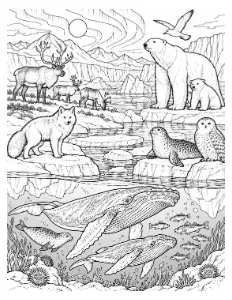
Animals
Seals — for meat, skins for clothes and boats, and oil for lamps.
Walrus — for meat, hide, and ivory tusks to carve.
Whales — their big bones became the frames of houses.
Caribou — for meat and warm skins.
Dogs — they pulled the sleds.
Things they made
Kayak — a small, closed boat for one hunter, made to fit his own body.
Umiak — a big open boat for carrying families and their things.
Dog sled — for travelling fast over snow and ice.
Toggling harpoon — a spear whose head turns sideways once it goes in, so it holds tight.
Snow goggles — carved from bone, ivory or wood, with a thin slit to look through. They protected the eyes from the bright snow.
Iglu — a snow house. The door tunnel is dug lower than the sleeping place, so cold air stays down and warm air stays up.
Seal-oil lamp — gave light and heat inside the house.
Wooden maps — in Greenland, people carved maps of the coastline that could be felt with the fingers in the dark. They float if they fall in the water!
Before the Thule came, the Dorset people lived in the eastern Arctic. Inuit stories call them the Tuniit and say they were so strong that one of them could drag a walrus alone.
Where this comes from. Everything on this page is drawn from the records of the time —
letters, logs, chronicles, codices and laws — and from what excavations have found. Where a
fact rests on a single account, the page names it.
Living books for Week 1 — North America
Arctic peoples, Adena and Hopewell, Poverty Point, Great Basin, Plateau, and Northwest Coast cultures
The chapter taught on video — from the Adventure Box podcast series,
week 1 of Ancient America.
W2:D2 — Arctic cultures, and how to survive in the Arctic
🎧 Podcast episode — Coming soon
From the Ultimate Guide — pages 53–64
Activity
Hands-on work from The Ultimate Ancient America Lesson Plan and
Activity Book. Pick one — you do not need to do all of them.
Traditional Inuit GamesAges 8–12
Play adapted versions of traditional Arctic games — the one-foot high kick, the blanket toss (with a sheet and a soft toy), finger pulls and knuckle hops. Discuss why games that build strength, balance and endurance mattered so much in that environment.
Why it is worth doing. Students feel why Arctic play was training, not just recreation.
Objective
Introduce students to traditional Inuit games, such as the "Blanket Toss," or "Knuckle Hop," which were played to develop physical strength and agility.
Materials Needed
For the "Blanket Toss:" A large blanket or tarp, and a group of students
For the "Knuckle Hop:" No special materials needed-just a padded surface for safety
Instructions
Blanket Toss: Have students/parents/adults hold the edges of the strong blanket and toss one student in the air, catching them safely each time. Ensure supervision and safety.
Knuckle Hop: Students get into a push-up position on their knuckles, and hop forward, using only their knuckles and toes.
Learning Outcome
Students will learn about traditional Inuit recreational activities, and the importance of physical fitness in Arctic cultures.
Build a Model Iglu or Skin TentAges 6–12
Use sugar cubes or white modelling clay for snow blocks, or cloth and sticks for a summer tent. Notice the spiral course of the blocks and the cold-trap entrance below floor level.
Why it is worth doing. Students understand that an iglu is a warm, engineered structure, not a pile of snow.
Objective
This activity involves constructing a small model of an igloo, helping students understand the architectural skills and techniques used by the Inuit.
Materials Needed
Sugar cubes or small marshmallows
Icing (as "cement")
A piece of cardboard or sturdy base
A plastic spoon (for spreading icing)
Instructions
Spread a layer of icing on the cardboard base.
Arrange the sugar cubes or marshmallows in a circle, sticking them together with icing.
Build up layers, gradually tapering the circle inward to form a dome shape.
Leave a small opening for the entrance.
Learning Outcome
Students will gain hands-on experience in building techniques, and learn about the insulation properties of igloos.
The Monthly Adventure Box ships
the craft kit for this era, so most of these arrive with the materials already cut.
Activity journal
Write about doing this activity. What did you actually make or do? What surprised you? What was harder than you expected, and what would you do differently next time? Then say one thing about The Arctic Culture that you understand better now than you did before you started.
Saved on this device as you type. Send to my parent account submits it to the
Xogos parent/teacher grade page — you can keep editing and send again.
Extra
Do not have the book with you? These cover the same chapter, free, on
our blog — read them on a phone at a kitchen table or in the back of a car.
8 questions drawn from a pool of 16, plus one to
write in your own words. Open book — you are meant to look things up.
How this one works. You get four attempts. Each retake takes 5 points off
the top, never more than 20 — so a perfect paper passes however many tries it took. The
pass mark is 80%, and passing is what opens the next chapter. Every attempt draws
a different paper.
Sign in to take the exam
Your attempts, your score and your place in the course are kept on your
account, so the exam needs to know who you are.